
Ontario Fireplace & Chimney Specialists
Gas Fireplace Annual Service in Windsor
The service that prevents most mid-winter no-heat calls.
Every job starts with a proper look at your system — not a guess over the phone. You get a written quote before any work begins, a clear explanation of what we found, and a technician who works to manufacturer and code requirements from start to finish.
- Written quotes, no surprise charges
- Photo-backed findings after every visit
- Work performed to code and manufacturer specs
- Serving Windsor and Essex County, year-round
Gas Annual Service for Windsor homes
Windsor has extensive pre-war and post-war brick housing with masonry chimneys, and near-universal natural gas service means most of those fireplaces have been converted or supplemented with gas appliances.
The milder winters here reduce freeze-thaw damage compared with the north, but persistent humidity keeps masonry damp, which shows up as efflorescence and interior staining rather than spalling.
Gas appliances accumulate dust on the burner ports, lint on the pilot assembly and film on the glass. Left alone, that produces lazy yellow flames, sooting and eventually a pilot that will not prove. An annual service resets all of it.
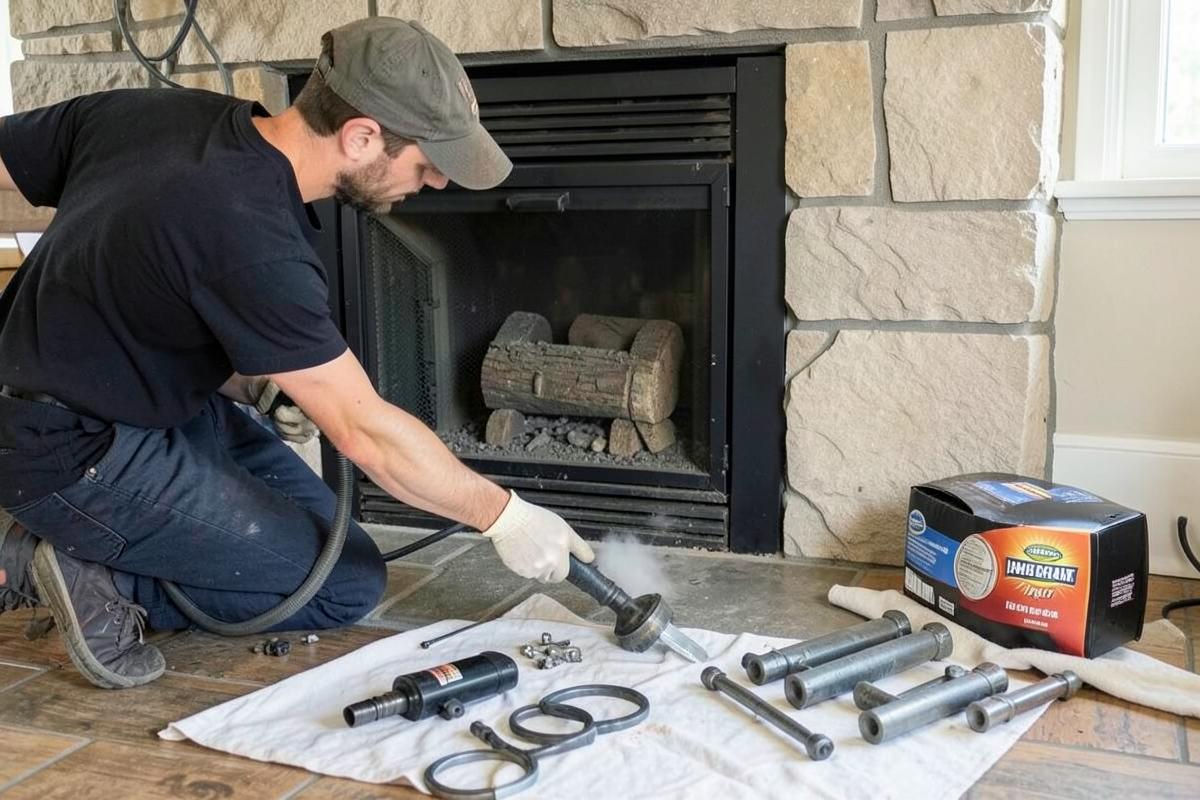
We disassemble the log set, vacuum and brush the burner and pilot, clean the glass and gasket, verify log positions against the manufacturer's diagram, test millivolt output and check the vent termination and seals.
What the visit includes
- Burner and pilot assembly cleaning
- Glass and gasket cleaning and inspection
- Log and ember placement to the listed diagram
- Millivolt, valve and ignition testing
- Vent termination, seal and clearance check
Signs you need this
- It has been more than a year since the last service
- Flames look lazy, yellow or uneven
- A film or haze building on the glass
- The unit smells strongly for the first hour of the season
Areas we cover around Windsor
Walkerville · Riverside · South Windsor · Sandwich · Forest Glade
A gas fireplace feels maintenance-free right up until the moment it is not, usually on the first genuinely cold night of the season when the pilot will not hold or the flame comes up ragged and yellow instead of clean and blue-orange. Almost every one of those calls traces back to a service that was skipped the year before, because gas appliances accumulate dust, lint and combustion byproducts slowly enough that nothing looks obviously wrong until the appliance simply refuses to cooperate.
Annual service exists to catch that slow accumulation before it becomes a shutdown. It is a mechanical and combustion check rolled into one visit: the burner ports get cleaned of dust, the pilot and thermocouple or thermopile get tested, the logs get checked against the manufacturer's placement diagram, and the vent termination gets inspected from outside. None of it takes long, and all of it is cheaper than an emergency call in January.
Ontario's climate makes the timing of this service matter more than people expect. A gas fireplace that sits unused all summer, often with a screened porch or garage door open nearby letting in dust and insects, is not the same appliance in September as it was in April. Booking service in late summer, ahead of the first cold snap, means any fault is found and parts ordered before the appliance is actually needed.
What a proper annual service actually covers
The visit starts with the glass front removed and the log set lifted out so the burner and firebox are fully accessible. Burner ports are brushed and vacuumed clear of dust and lint, since even a partially blocked port changes the flame pattern from a clean, even burn to a lazy, uneven one that produces visible soot.
The pilot assembly and either the thermocouple or thermopile, depending on ignition type, are cleaned and tested for correct millivolt output. A pilot that lights but will not hold once you release the control knob is almost always a weak thermocouple reading below the appliance's threshold, and it is one of the most common single-part failures on older units.
Glass and gasket condition, log and ember bed placement against the manufacturer's diagram, valve operation, and the vent termination outside all get checked in the same visit, since a fault in any one of these areas produces symptoms that look similar from the living room, and running through them systematically is the only reliable way to find the actual cause.
- Burner port cleaning and flame pattern check
- Pilot, thermocouple or thermopile testing
- Glass and door gasket inspection
- Log and ember placement against the listed diagram
- Vent termination and exterior clearance check
Direct vent versus B-vent, and why it changes the service
Direct vent gas fireplaces draw combustion air from outside through a sealed intake and exhaust through a separate sealed pipe, which means the appliance's seal integrity around the glass and firebox door matters enormously; a failed gasket lets room air leak into a system designed to be closed. Checking that seal is a routine part of servicing a direct vent unit and is easy to overlook if the technician is not specifically looking for it.
B-vent units instead draw combustion air from the room and exhaust through a single vertical vent, closer in principle to an old chimney flue. These need adequate room air supply confirmed and the vent termination checked for the kind of blockage, such as bird nesting or ice buildup, that can accumulate over an Ontario winter without anyone noticing from inside.
Seasonal buildup and the Ontario heating cycle
Most Ontario homes run their gas fireplace hardest between November and March, which means the appliance goes through one long stretch of near-daily use followed by five or six months of sitting idle. That idle period is when dust settles into the burner, insects occasionally find their way into vent terminations, and any small leak or seal issue has time to worsen without anyone noticing because the appliance simply is not running.
Servicing in late summer catches the appliance at the point where a full season of dust has settled but before demand for heat makes any downtime inconvenient. It also means any parts needing replacement, such as a thermocouple or a gasket, can be ordered without the wait that builds up industry-wide once temperatures drop and every fireplace company's schedule fills at once.
Code and safety framework behind the annual visit
Gas-burning appliances in Ontario fall under provincial gas safety regulation enforced through TSSA, and manufacturers list specific annual maintenance requirements as a condition of the appliance's certification remaining valid. Skipping service does not just risk a breakdown; on older units it can also affect whether a warranty claim is honoured if something like a cracked heat exchanger is found later.
The technical checks during service, particularly millivolt testing of the pilot safety system and the vent termination inspection, exist because a gas appliance that fails to shut off correctly, or that vents improperly into a room, is a genuine safety hazard rather than just an inconvenience. That is the underlying reason this service is framed as an annual requirement rather than an optional extra.
What the findings actually mean
A weak millivolt reading on the pilot safety device means the appliance is at risk of shutting itself down mid-season, which is inconvenient but is the system working as designed rather than failing dangerously. A cracked heat exchanger, by contrast, is a genuine stop-use finding, since it can allow combustion gases to mix with room air, and it is one of the reasons a thorough visual inspection of the firebox interior is part of every service.
Sooting on the glass or logs almost always traces back to either incorrect log placement or a burner port partially blocked with dust, both of which are corrected in the same visit. A persistent gas smell, on the other hand, is never something to wait on and should be treated as an immediate call rather than something noted for the next scheduled service.
Repair versus replacement on an aging unit
Most individual gas fireplace faults, a bad thermocouple, a failed gasket, a sticking valve, are inexpensive and quick to repair, and there is rarely a reason to consider replacement over them on their own. The calculation changes when the appliance is fifteen to twenty years old and multiple systems are showing wear at once, because parts availability for discontinued models becomes the limiting factor rather than the cost of any single repair.
A cracked heat exchanger on an older unit is usually the point where replacement becomes the sensible answer, since it is rarely cost-effective to replace on its own and its presence often signals the appliance has reached the end of its practical service life regardless of what else might still work.
Resale and insurance relevance of a documented service history
A gas fireplace with a documented annual service history is a small but real point in favour of a home during resale, particularly for a buyer who has been through the experience of inheriting a fireplace with no maintenance records and no way to know what condition it is actually in. Keeping receipts or service reports together gives a future buyer, or a home inspector working on their behalf, something concrete to look at.
On the insurance side, some carriers ask directly about fireplace maintenance when underwriting or renewing a policy, particularly after a claim involving fire or smoke damage elsewhere in a home. A service record showing the pilot safety system, vent termination and firebox condition were checked within the past year is straightforward evidence that the appliance has been reasonably maintained.
Gas Fireplace Annual Service cost in Windsor
A standard annual gas fireplace service in Ontario typically averages around $220 including a basic parts check.
| Work | Typical range | What moves the price |
|---|---|---|
| Standard annual gas fireplace servicesingle appliance, no parts required | $180 – $280 | single appliance, no parts required |
| Thermocouple or thermopile replacementpart cost plus labour during service | $90 – $170 | part cost plus labour during service |
| Glass gasket replacementsize and gasket type | $60 – $130 | size and gasket type |
| Full valve or control module diagnosis and replacementparts availability for the model | $220 – $480 | parts availability for the model |
| Vent termination clearing or repairaccess height and blockage cause | $140 – $320 | access height and blockage cause |
| Multi-unit service in one visitdiscount typically applied for same-visit units | $140 – $220 per additional unit | discount typically applied for same-visit units |
Ranges are estimates for planning only, not quotes. Final pricing depends on what we find on site, access, and the condition of the existing system.
What moves the price
- Whether the unit has gone multiple years without service
- Parts needed such as a thermocouple, gasket or igniter
- Direct vent versus B-vent inspection requirements
- Vent termination accessibility, especially on upper storeys
- Number of gas appliances serviced in the same visit
- Age of the unit and availability of manufacturer parts
Want a number for your own fireplace? Send us the details and we will come back with an estimate, or call (833) 949-4153.
How the work goes, step by step
- 1
Shutdown and disassembly
The gas supply is shut off, the glass front removed and the log set carefully lifted out and set aside so the burner, pilot and firebox interior are fully accessible for cleaning and inspection.
- 2
Burner and pilot cleaning
Burner ports are brushed and vacuumed clear of dust and lint, and the pilot assembly is cleaned so the flame can burn evenly across every port once the appliance is reassembled and relit.
- 3
Safety and ignition testing
The thermocouple or thermopile is tested for correct millivolt output, ignition is cycled several times to confirm reliable lighting, and the safety shutoff response is checked.
- 4
Log placement and glass check
Logs and ember material are repositioned to match the manufacturer's diagram exactly, and the glass panel and door gasket are inspected for cracks, haze or seal failure.
- 5
Vent termination inspection
The exterior vent termination is checked for blockage, nesting material, ice or physical damage, and clearances to nearby structures or vegetation are confirmed against the appliance's listing.
- 6
Reassembly and final flame check
The unit is reassembled, run through a full cycle, and the flame pattern is visually confirmed clean and even across the burner before the appointment is closed out.
How long it takes: A single-unit annual service typically takes 45 minutes to an hour, longer if a part needs to be sourced and replaced during the same visit.
Looking after it afterwards
- Run the fireplace for a few minutes a month even in the off-season to keep seals from drying out
- Keep the area in front of the glass clear of furniture and rugs per the clearance label
- Wipe the glass only when cool and only with a gas-fireplace-rated cleaner
- Report any change in flame colour, noise or smell promptly rather than waiting for the next service
- Keep the vent termination clear of snow drift and fallen leaves through the season
Mistakes we see most often
- Skipping service because the fireplace lit fine last winter
- Cleaning the glass with household glass cleaner, which can etch it
- Ignoring a pilot that struggles to stay lit until it fails outright
- Letting logs shift out of position over repeated use without correcting them
- Booking service only after the first cold snap when schedules are full
Questions homeowners ask
- When is the best time to book?
- Late summer or early autumn. Booking before the first cold snap avoids the queue that forms the week temperatures drop.
- Does log placement really matter?
- Considerably. Logs out of position interrupt the flame path, which is the leading cause of soot on the glass and inside the firebox.
- Why does my pilot light but the fireplace still won't turn on?
- This usually points to the thermocouple or thermopile not generating enough millivolt output to hold the gas valve open once you release the control, or to the wall switch or remote receiver itself. Both are quick to test and inexpensive to replace.
- Is it normal for a gas fireplace to smell when first turned on each season?
- A faint, temporary odour from dust burning off the burner is common in the first several minutes after months of disuse. A persistent gas odour is different and should prompt shutting the appliance off and calling for service immediately.
- Can I do the annual service myself?
- Basic tasks like dusting the glass exterior and checking for visible obstructions are fine to do yourself, but burner disassembly, gas valve testing and vent inspection involve components that should be handled by someone trained on gas appliances.
- How long does a gas fireplace typically last before needing replacement?
- Many well-maintained units run reliably for fifteen to twenty-five years, though components like gaskets and igniters wear out well before then and are simply replaced as needed rather than signalling the whole unit is done.
- Does the service check for carbon monoxide risk?
- Yes, in the sense that a thorough visual inspection of the heat exchanger and combustion chamber, along with proper vent termination checks, is specifically aimed at catching the kind of damage that could allow flue gases to escape into the room.
- What is the yellow flame I sometimes see actually a sign of?
- A persistent yellow, sooty flame usually means incomplete combustion, often from dust-blocked burner ports, incorrect log placement, or inadequate combustion air, and it is worth having checked because it also increases soot deposits inside the appliance over time.
Nearby
Other Communities Near Windsor
Related work
Often Booked Together
Gas Fireplace Repair in Windsor
Licensed diagnosis and repair of pilots, valves, ignitions, blowers and remote controls.
Gas Fireplace Installation in Windsor
Direct-vent and B-vent gas fireplace installation by licensed gas technicians.
Gas Conversion in Windsor
Converting wood-burning fireplaces to gas inserts or log sets, with proper relining.
Chimney Sweeping in Windsor
Full mechanical sweep of the flue, smoke chamber and firebox with containment and photos.