
Ontario Fireplace & Chimney Specialists
Smoke Guard Installation in Goderich
Sometimes the fix for a smoking fireplace is changing the shape of the opening.
Every job starts with a proper look at your system — not a guess over the phone. You get a written quote before any work begins, a clear explanation of what we found, and a technician who works to manufacturer and code requirements from start to finish.
- Written quotes, no surprise charges
- Photo-backed findings after every visit
- Work performed to code and manufacturer specs
- Serving Goderich and Huron County, year-round
Smoke Guard for Goderich homes
Goderich's distinctive older core holds substantial brick homes with tall masonry chimneys, many with original clay tile behind decades of surface repairs.
Direct Huron exposure keeps masonry wet and cycling, and camera inspection is often the only way to show whether a tile liner behind sound-looking brick is still intact.
A fireplace drafts properly only when the opening area is proportionate to the flue area, roughly one part flue to ten parts opening for a typical masonry system. Many older fireplaces were built with openings too large for their flue and have smoked since the day they were finished.
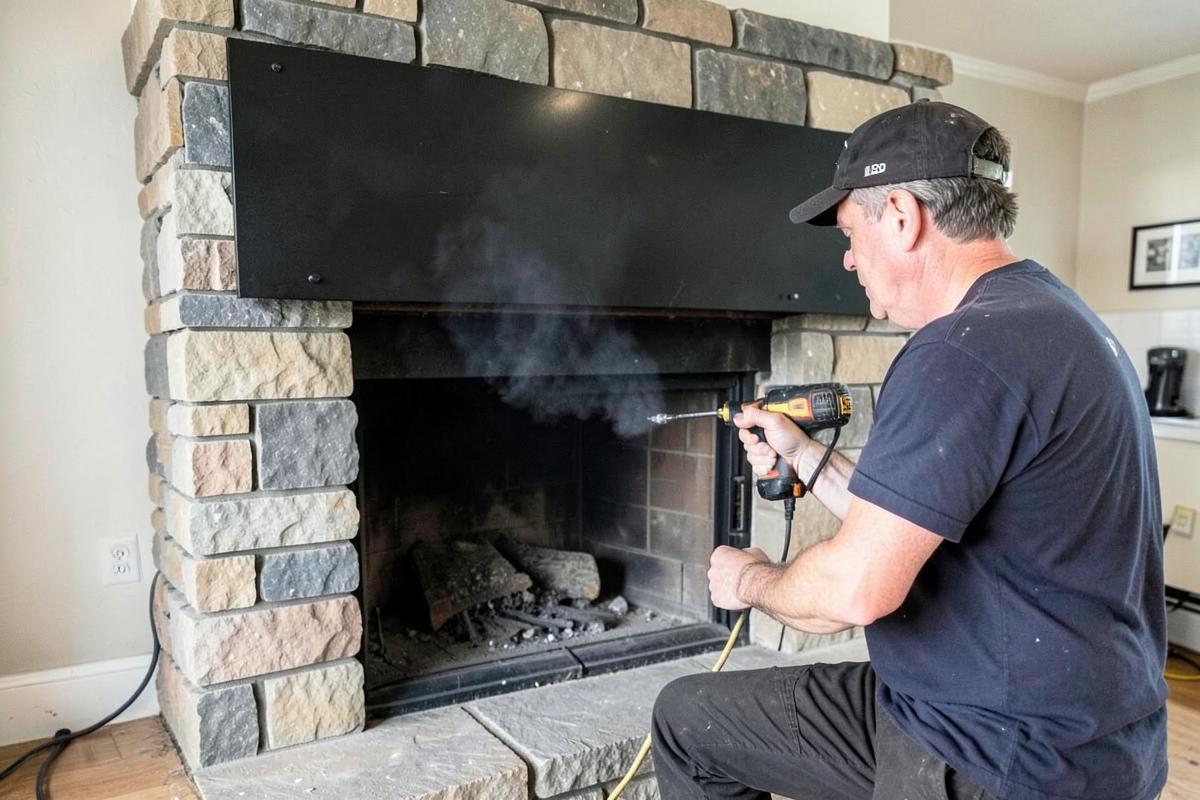
A smoke guard reduces the effective opening height and restores that ratio, often turning a chronically smoky fireplace into a well-behaved one. We measure and test before fitting, and address blockage, chamber roughness and combustion air at the same time.
What the visit includes
- Opening-to-flue ratio measurement
- Draft testing and combustion air assessment
- Smoke guard sizing and finish selection
- Installation and re-testing under fire
- Smoke chamber and blockage review
Signs you need this
- The fireplace has always smoked, even when clean
- Smoke rolls out of the top of the opening
- Soot staining above the fireplace opening
- Smoking that worsens when the range hood runs
Areas we cover around Goderich
Bayfield · Clinton · Benmiller · Holmesville · Port Albert
A smoke guard is a retractable metal strip mounted just inside the top of a fireplace opening that can be lowered to reduce the opening's effective height, which in turn improves draft performance on fireplaces that intermittently puff smoke into the room under certain conditions. It is a targeted fix for a specific and fairly common problem: a firebox opening that is proportionally too large relative to the flue size serving it, a mismatch that shows up more often in older masonry fireplaces built before modern sizing ratios were standardized.
Unlike a full damper or a chimney fan, a smoke guard is a relatively low-cost, non-invasive addition that does not alter the chimney structure itself, and it can often be adjusted by the homeowner on a fire-by-fire basis once installed, lowering it further on days when draft conditions are weaker and raising it when the fire is drawing strongly on its own.
This page explains when a smoke guard is the appropriate fix, how it works alongside other draft-related repairs, what installation involves, and realistic costs for this often-overlooked but genuinely useful accessory.
Understanding the opening-to-flue ratio problem
Traditional fireplace design relies on a reasonably consistent ratio between the firebox opening's area and the flue's cross-sectional area, since a flue that is too small relative to a large opening cannot move enough air to fully contain the smoke and heat rising from a fire at that opening size. Many older Ontario masonry fireplaces, particularly those built as decorative or occasional-use features rather than primary heat sources, have openings that are generously sized for visual effect but were never matched precisely to an appropriately larger flue.
This mismatch often shows up specifically during weaker draft conditions: on mild days when there is less temperature differential to drive natural convection, on very windy days when the chimney termination experiences turbulent airflow, or early in a fire before the flue has warmed up enough to establish strong draft. A smoke guard directly addresses this by temporarily reducing the effective opening size to better match what the existing flue can actually handle.
When a smoke guard is the appropriate solution
A smoke guard makes the most sense for a fireplace with an otherwise sound, properly swept and structurally intact flue that simply has an opening larger than ideal for that flue's size, particularly when the smoking problem is intermittent rather than constant, occurring mainly at fire startup or under specific wind conditions rather than every single time the fireplace is used.
It is not the right fix for smoke problems caused by a blocked or heavily creosote-coated flue, a damaged damper, or a chimney that is genuinely undersized relative to code height requirements for its location, since those underlying issues need their own specific repair regardless of what opening size is presented to them. A proper inspection to rule out these other causes should precede a smoke guard recommendation.
Homes where the smoking problem coincides with modern airtightness upgrades, such as new windows or added insulation reducing natural infiltration air available to the fireplace, may find a smoke guard alone insufficient, and pairing it with a dedicated outdoor combustion air supply often addresses the underlying makeup air shortage more completely.
Seasonal households that only light a fireplace occasionally, such as a cottage used mainly in summer with an early autumn fire now and then, are a common candidate for this fix, since an infrequently used opening-to-flue mismatch may never have been diagnosed simply because there was never enough regular use to prompt someone to investigate a recurring but rare annoyance.
How a smoke guard physically works
The device consists of a curved or flat metal strip mounted on a roller or track system just behind the fireplace opening's lintel, operated by a handle or knob that the homeowner uses to raise or lower it to the desired position. Lowering the guard reduces the opening's visible height, which concentrates the same volume of rising smoke and hot air into a smaller area, increasing velocity and improving the fireplace's ability to draw that smoke fully into the flue rather than letting some of it spill out into the room.
Guards are typically adjustable through a range of positions rather than being a fixed single setting, allowing a homeowner to find the minimum reduction needed to solve the smoking problem on a given day, since lowering it more than necessary unnecessarily restricts the view of the fire without additional benefit.
- Mounted on a roller or track just inside the fireplace lintel
- Adjustable across a range of positions rather than a single fixed setting
- Operated manually by the homeowner before or during a fire
Sizing and selecting the right guard
Smoke guards are manufactured in standard width ranges and need to be matched to the specific fireplace opening's width, with some models offering an adjustable or trimmable width to fit openings that fall between standard sizes. Getting this measurement right during selection avoids gaps at the sides of the guard that would undermine its effectiveness by allowing smoke to bypass the reduced opening at the edges.
Material and finish selection generally follows the fireplace's existing hardware finish, since the guard sits in a visible location at the top of the opening, and most manufacturers offer several finish options to coordinate with existing black, brass or nickel-toned fireplace hardware already in the room.
Installation considerations
Installation requires accurate measurement of the opening and secure mounting into the masonry or metal surround above the firebox opening, using fasteners and anchors rated for the heat exposure at that specific location just inside the fireplace face. A poorly mounted guard can loosen or sag over time from repeated heat cycling, which both reduces its effectiveness and creates a minor safety concern if it were to detach during use.
For factory-built metal fireplaces, compatibility with a smoke guard needs to be confirmed against the manufacturer's specifications, since not every factory-built unit is designed to accommodate this kind of aftermarket addition, and installing one without confirming compatibility can void certain warranty or listing considerations for the appliance.
Using a smoke guard effectively
Homeowners should experiment with the guard's position over their first several fires after installation to find the setting that resolves smoking under their typical conditions without restricting the opening more than necessary, keeping in mind that conditions can vary meaningfully between a calm evening and a windy one, or between the fire's early minutes and once it is well established.
It is worth noting that a smoke guard needs to be raised fully before cleaning out ash or performing other firebox maintenance that requires full access to the opening, and it should be checked periodically for smooth operation, since a guard that has become difficult to raise or lower defeats its purpose as an adjustable, fire-by-fire tool.
Complementary fixes worth considering alongside a smoke guard
A smoke guard works best as part of a broader draft assessment rather than as a standalone purchase, and homeowners dealing with a smoking fireplace should have the flue swept and camera-inspected first to rule out buildup or damage as the actual cause before assuming an opening-size mismatch is the issue.
In cases where the smoke guard alone does not fully resolve the problem, particularly in a tightly sealed modern home, adding a dedicated outdoor air supply directly to the firebox can address a makeup air shortage that no amount of opening-size adjustment will fix on its own, since the fundamental issue in that case is total air availability rather than opening geometry.
- Sweep and camera-inspect the flue before assuming opening size is the cause
- Combine with a dedicated outdoor air supply if makeup air is limited
- Reassess damper operation and seal at the same time as a broader draft evaluation
Comparing a smoke guard to structural alternatives
For a fireplace with a genuinely and severely mismatched opening-to-flue ratio, some homeowners consider a more invasive fix such as reducing the firebox opening permanently through masonry modification, rather than relying on an adjustable guard used at each fire. This is a considerably larger and more disruptive project than installing a guard, and it permanently changes the fireplace's appearance, so it is generally reserved for cases where a guard has been tried and found insufficient rather than pursued as a first option.
Relining a flue to a properly matched diameter is another structural alternative worth comparing, particularly if the flue also shows other condition issues that would justify the work independently of the smoking problem, since addressing both concerns through a single reline can be more cost-effective in the long run than a series of smaller individual fixes over time.
In most cases, however, a smoke guard remains the more proportionate first response to a moderate mismatch, reserving the larger structural options for situations where the smoke guard's adjustable range genuinely cannot resolve the issue across the range of conditions the fireplace is actually used in.
Smoke Guard Installation cost in Goderich
A typical smoke guard installation in Ontario, including a basic draft check, costs between $250 and $450.
| Work | Typical range | What moves the price |
|---|---|---|
| Standard smoke guard, supplied and installedtypical single-fireplace opening within standard width ranges | $180 – $320 | typical single-fireplace opening within standard width ranges |
| Adjustable-width smoke guard for a non-standard openingcustom-fit hardware for wider or unusually shaped openings | $260 – $420 | custom-fit hardware for wider or unusually shaped openings |
| Premium finish smoke guard matched to existing hardwarebrass, nickel or custom finish coordinated with room decor | $220 – $380 | brass, nickel or custom finish coordinated with room decor |
| Combined draft assessment and smoke guard installationincludes camera inspection to rule out other causes first | $350 – $550 | includes camera inspection to rule out other causes first |
| Outdoor combustion air kit add-onaddresses makeup air shortage where a guard alone is insufficient | $400 – $750 | addresses makeup air shortage where a guard alone is insufficient |
| Factory-built fireplace compatibility check and installationconfirms manufacturer compatibility before mounting | $220 – $400 | confirms manufacturer compatibility before mounting |
Ranges are estimates for planning only, not quotes. Final pricing depends on what we find on site, access, and the condition of the existing system.
What moves the price
- Fireplace opening width and whether it falls within standard manufactured sizes
- Finish selection to coordinate with existing fireplace hardware
- Whether a full draft assessment and camera inspection is bundled with installation
- Compatibility verification needed for factory-built metal fireplace units
- Whether an outdoor combustion air kit is added to address makeup air limitations
- Mounting complexity for unusual lintel or surround materials
Want a number for your own fireplace? Send us the details and we will come back with an estimate, or call (833) 949-4153.
How the work goes, step by step
- 1
Diagnose the smoking pattern
The technician reviews when and how often smoking occurs to help confirm an opening-to-flue size mismatch is the likely cause.
- 2
Inspect the flue
A camera inspection or sweep rules out creosote buildup, damage or blockage as the actual underlying cause before proceeding.
- 3
Measure the opening
Exact width and mounting surface conditions are measured to select an appropriately sized and finished smoke guard.
- 4
Mount the hardware
The guard's roller or track mechanism is securely fastened into the masonry or surround just inside the fireplace opening.
- 5
Test operation
The guard is raised and lowered through its full range to confirm smooth movement and proper fit across the opening width.
- 6
Demonstrate use
The homeowner is shown how to adjust the guard for different fire conditions and how to raise it fully for ash cleanout access.
How long it takes: A standard smoke guard installation typically takes one to two hours, including a basic pre-installation draft check.
Looking after it afterwards
- Raise the guard fully before cleaning ash or performing other firebox maintenance
- Adjust the guard position for varying wind and weather conditions on different burn days
- Check the mounting periodically for looseness from repeated heat cycling
- Combine with annual sweeping and inspection rather than treating it as a one-time complete fix
- Consider a dedicated outdoor air supply if smoking persists despite proper guard adjustment
Mistakes we see most often
- Installing a smoke guard without first ruling out flue blockage or damage as the real cause
- Choosing a guard sized incorrectly for the opening, leaving gaps at the sides
- Forgetting to raise the guard before attempting to clean out the firebox
- Assuming a guard alone will fix smoking caused by a genuine makeup air shortage
- Mounting hardware without confirming compatibility on a factory-built metal fireplace
Questions homeowners ask
- Is a smoke guard visible?
- It is a slim band across the top of the opening, usually in a finish that matches the doors or surround. Most people stop noticing it quickly.
- What else causes smoking?
- Blockage, a rough smoke chamber, a short chimney, and a house too airtight to supply combustion air. We check all four before suggesting a guard.
- Can a smoke guard be removed entirely if it is no longer needed?
- Yes, since it mounts as a discrete accessory rather than altering the fireplace opening permanently, and it can be taken down without leaving the structure any different than it was before installation, though the mounting hardware may leave small, easily patched holes in the surround.
- Does installing a smoke guard require a permit or inspection?
- No, since it is a minor accessory addition rather than a structural change to the chimney or firebox, and it does not typically trigger any municipal permitting requirement the way more invasive masonry modifications or new appliance installations would.
- Will a smoke guard reduce how much I can see of the fire?
- It does reduce the visible opening height somewhat when lowered, though most homeowners find the effect modest at the minimum setting needed to resolve their specific smoking issue, and the guard can be raised fully when not needed.
- Can a smoke guard fix a chimney that never draws well at all?
- Only if the underlying cause is genuinely an opening-to-flue size mismatch; a chimney with a structural draft problem, height deficiency or blockage needs that specific issue addressed directly rather than relying on a smoke guard to compensate for it.
- Is a smoke guard adjustable myself, or does a technician need to reset it each time?
- It is designed for the homeowner to adjust as needed before or during a fire, similar to opening or closing a damper, and does not require a technician visit for routine day-to-day adjustment.
- Does a smoke guard work on a gas fireplace?
- It is primarily used on open, wood-burning masonry fireplaces where the draw depends on opening geometry in this way; most gas fireplaces are sealed or glass-fronted units where this kind of adjustable opening reduction does not apply.
- How long does a smoke guard typically last?
- With reasonable care and periodic mounting checks, a quality smoke guard commonly lasts many years, since it is a simple mechanical device without complex moving parts beyond its roller or track mechanism.
- Should I try a smoke guard before or after having my flue inspected?
- After, ideally, since ruling out buildup or damage first ensures the smoke guard is actually addressing the real cause of the problem rather than being installed on a fireplace with an unrelated, more serious underlying issue.
Nearby
Other Communities Near Goderich
Related work
Often Booked Together
Fireplace Repair in Goderich
Diagnosis and repair of fireboxes, dampers, doors, screens and hearth components.
Fireplace Installation in Goderich
New fireplace installation with correct venting, clearances and finished surround.
Insert Installation in Goderich
Gas, wood and electric inserts fitted into existing masonry openings with proper liners.
Glass Doors in Goderich
Custom-fitted glass doors that reduce heat loss and keep sparks in the firebox.