Ontario Fireplace & Chimney Specialists
Pellet Stove Service in Walkerton
Pellet stoves need cleaning more often than any other hearth appliance.
Every job starts with a proper look at your system — not a guess over the phone. You get a written quote before any work begins, a clear explanation of what we found, and a technician who works to manufacturer and code requirements from start to finish.
- Written quotes, no surprise charges
- Photo-backed findings after every visit
- Work performed to code and manufacturer specs
- Serving Walkerton and Bruce County, year-round
Pellet Stove Service for Walkerton homes
Walkerton's older brick housing carries clay-tile or unlined flues, and the farms around it commonly heat with wood stoves or outdoor wood furnaces.
Unseasoned fuel is the usual driver of heavy creosote on farm properties here, so we pair sweeping with a straightforward conversation about wood storage and burn practice.
Pellet appliances move fuel and air mechanically, so ash accumulates in the burn pot, the heat exchanger and the exhaust path much faster than in other stoves. Once that ash restricts airflow, the stove throws error codes and shuts down.
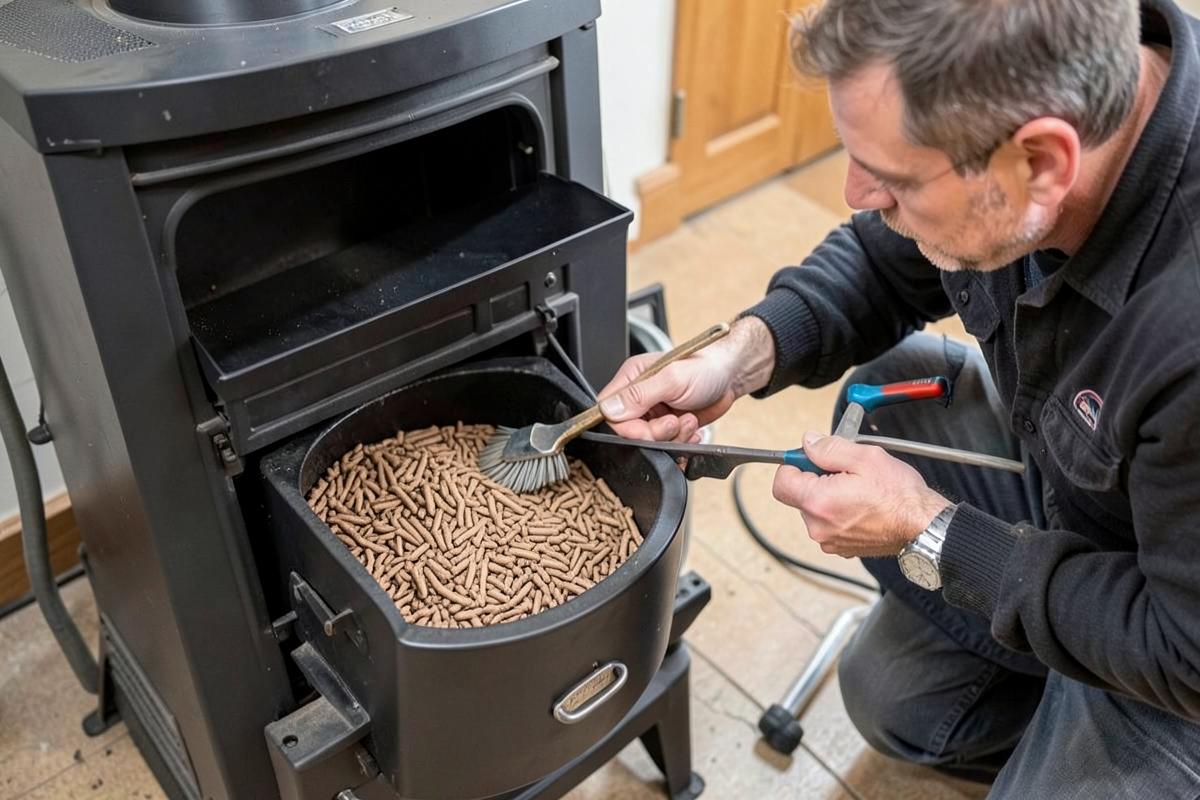
A full service strips and cleans the burn pot, heat exchanger and exhaust run, inspects the auger and its motor, tests the combustion and convection fans, replaces gaskets, and confirms the vacuum switch and control board are behaving.
What the visit includes
- Burn pot, ash pan and heat exchanger cleaning
- Full exhaust run and vent termination cleaning
- Auger, hopper and feed motor inspection
- Combustion and convection fan testing
- Gasket, vacuum switch and control board checks
Signs you need this
- The stove shuts down with an error code
- Frequent ignition failures
- Unusually loud or rattling fan noise
- Poor heat output with normal pellet consumption
Areas we cover around Walkerton
Mildmay · Teeswater · Cargill · Hanover · Chepstow
Pellet stoves burn cleaner and more consistently than wood stoves in many respects, but they trade that consistency for a mechanical complexity that wood stoves simply do not have. An auger feeds fuel, fans manage both combustion and room air circulation, a control board runs the whole sequence, and every one of those moving parts needs attention on a schedule considerably shorter than a wood stove's annual service.
Ash accumulates faster in a pellet stove than in almost any other hearth appliance, not because pellets are dirtier fuel but because the mechanical feed and forced airflow move that ash around continuously rather than letting it settle in one place the way an open wood fire does. Left unaddressed, ash restricts airflow through the burn pot and heat exchanger, and once that happens the stove's control board typically responds by throwing an error code and shutting the unit down entirely rather than limping along inefficiently.
That shutdown behaviour is actually a deliberate safety feature rather than a flaw, but it means pellet stove owners experience appliance problems more abruptly than wood stove owners do. A wood stove that needs service tends to burn a little worse for a while before it becomes a real problem; a pellet stove that needs service is often working perfectly one day and refusing to start the next.
Why pellet stoves need cleaning more often than any other appliance
The burn pot, where pellets actually combust, accumulates clinker and ash directly in the airflow path that the stove depends on for combustion air, and this buildup happens measurably faster than ash accumulation in a wood stove firebox because of the smaller, more concentrated combustion zone pellet stoves use. Light users can extend the interval between cleanings, but most manufacturers recommend attention to the burn pot on a weekly basis during the heating season.
Beyond the burn pot, the heat exchanger tubes that transfer combustion heat into room air develop a fly-ash coating over weeks of operation, and that coating measurably reduces heat output even while the stove continues running and burning fuel normally, meaning declining performance is not always obvious until a full service reveals how much buildup has actually occurred.
The exhaust path and vent termination accumulate ash and, in humid Ontario conditions, occasionally a tar-like residue from incomplete combustion, both of which restrict exhaust flow enough over a season to trigger the vacuum switch that most pellet stoves use as a safety shutoff when adequate airflow cannot be confirmed.
What a full annual service covers
A complete service strips down considerably more of the stove than routine homeowner cleaning reaches. The burn pot, ash pan and heat exchanger are fully cleaned, often requiring the heat exchanger tubes to be brushed individually to remove fly ash that a vacuum alone cannot reach. The full exhaust run, including the vent termination outside, is cleaned end to end rather than just at the accessible ends.
The auger, hopper and feed motor are inspected for wear, since a slipping or intermittently jamming auger produces symptoms that look identical to a control board fault from the outside but are mechanical rather than electronic. Combustion and convection fans are tested for correct speed and any bearing noise that indicates wear.
Door and hopper lid gaskets are checked for seal integrity, and the vacuum switch and control board are tested to confirm they are responding correctly to actual airflow conditions rather than triggering falsely or, more concerning, failing to trigger when they should.
- Burn pot, ash pan and heat exchanger deep cleaning
- Full exhaust run and exterior vent termination cleaning
- Auger, hopper and feed motor mechanical inspection
- Combustion and convection fan speed and bearing testing
- Gasket seal check and vacuum switch verification
Pellet quality and its outsized effect on service needs
Pellet quality varies more than many owners expect, and low-quality, high-ash pellets can genuinely multiply how often a stove needs cleaning compared to premium, low-ash pellets burned in the same appliance. Some of the shutdown and performance complaints attributed to a stove being faulty actually trace back entirely to pellet choice rather than any mechanical issue.
Ontario's pellet market includes a wide range of products, and checking the ash content percentage listed on a bag, generally under one percent for premium pellets, gives a reasonably reliable signal of how much cleaning burden a given fuel will add over a season. Switching pellet brands is sometimes the single most effective change an owner can make to reduce how often professional service is needed.
Cold-weather operation and error codes specific to Ontario winters
Pellet stoves rely on their exhaust fan and vacuum switch to confirm adequate draft before allowing ignition, and cold outdoor temperatures combined with wind at the vent termination can occasionally affect that draft reading enough to trigger a false shutdown, particularly on stoves with a marginally undersized or poorly located vent run. This is more of an installation and venting design issue than a service issue, but it often surfaces as an error code that prompts a service call.
Genuine service-related shutdowns are far more commonly linked to airflow restriction from ash buildup than to any weather-driven cause, and distinguishing between the two, whether the error is a real mechanical fault or an environmental condition affecting a marginal system, is one of the more valuable parts of a proper diagnostic visit rather than simply resetting the stove and hoping the code does not return.
Code and safety context for pellet appliances
Pellet stoves are certified appliances under CSA or ULC listings similar to wood stoves, and their installation and venting fall under the same general solid-fuel provisions of the Ontario Building Code, though the mechanical venting system, powered rather than relying purely on natural draft, has its own specific listing requirements for vent pipe and termination clearances. Service work that affects the vacuum switch or exhaust fan directly touches the safety systems the appliance's certification depends on.
The vacuum switch specifically exists to shut the stove down if adequate exhaust flow cannot be confirmed, preventing combustion gases from being pushed back into the room rather than safely exhausted outside. A technician disabling or bypassing that switch to stop nuisance shutdowns, rather than fixing the underlying airflow restriction causing them, defeats a genuine safety feature and should never be treated as an acceptable fix.
Diagnosing error codes and what they actually mean
Most pellet stove control boards display a specific error code rather than a generic fault light, and those codes generally point toward one of a handful of causes: an ignition failure, usually from a dirty igniter or fuel feed issue; an airflow or vacuum fault, usually from ash restriction somewhere in the burn pot or exhaust path; or a feed system fault, usually from auger jamming or motor wear.
Reading the specific code correctly and checking the corresponding system directly is considerably faster and cheaper than a generic cleaning that may not address the actual restriction or component causing the shutdown. Keeping the stove's manual, which lists code meanings for that specific model, on hand speeds up this process considerably when a fault does occur.
Repair versus replacement, and the resale angle
Individual pellet stove component failures, an igniter, a feed motor, a fan, are almost always worth repairing rather than replacing the stove, since these are standard wear parts across most brands and remain available even on stoves that are a decade or more old in many cases. The auger motor and control board are the two costlier components, and replacing either on a stove already showing broader wear elsewhere is the point worth weighing against a full replacement.
For resale, a pellet stove with a documented annual service history reassures a buyer considerably more than one with no records, given how mechanically involved these appliances are compared to a wood stove, and given that many buyers unfamiliar with pellet stoves specifically ask about maintenance history before agreeing to keep the appliance as part of a sale rather than have it removed.
Pellet Stove Service cost in Walkerton
A full annual pellet stove service in Ontario typically averages around $270 including exhaust and burn pot cleaning.
| Work | Typical range | What moves the price |
|---|---|---|
| Full annual pellet stove servicesingle unit, no major parts required | $220 – $340 | single unit, no major parts required |
| Exhaust run and vent termination cleaningvent length and termination accessibility | $150 – $260 | vent length and termination accessibility |
| Auger or feed motor replacementpart availability and model | $180 – $380 | part availability and model |
| Combustion or convection fan replacementfan type and access difficulty | $140 – $300 | fan type and access difficulty |
| Control board diagnosis and replacementboard availability and model age | $250 – $500 | board availability and model age |
| Gasket and vacuum switch servicegasket size and switch condition | $90 – $190 | gasket size and switch condition |
Ranges are estimates for planning only, not quotes. Final pricing depends on what we find on site, access, and the condition of the existing system.
What moves the price
- How heavily the stove has been used through the season
- Pellet quality and ash content burned through the year
- Whether the auger, motor or control board need replacement
- Exhaust run length and vent termination accessibility
- Age of the unit and manufacturer parts availability
- Whether error code diagnosis reveals a mechanical or venting cause
Want a number for your own fireplace? Send us the details and we will come back with an estimate, or call (833) 949-4153.
How the work goes, step by step
- 1
Burn pot and ash pan cleaning
The burn pot is removed and cleaned of clinker and ash buildup restricting combustion airflow, and the ash pan is emptied and inspected for any unusual residue indicating a fuel or airflow issue.
- 2
Heat exchanger and exhaust cleaning
Heat exchanger tubes are brushed individually to remove fly ash, and the full exhaust run through to the exterior vent termination is cleaned to restore proper draft and airflow.
- 3
Auger and feed system inspection
The auger, hopper and feed motor are inspected for wear, jamming or slipping, since feed inconsistency produces symptoms that can otherwise be mistaken for a control board fault.
- 4
Fan testing
Combustion and convection fans are tested for correct operating speed and checked for bearing noise or wear that would reduce airflow or eventually lead to fan failure.
- 5
Gasket and vacuum switch verification
Door and hopper gaskets are checked for seal integrity, and the vacuum switch is tested to confirm it responds correctly to genuine airflow conditions rather than triggering falsely or failing silently.
- 6
Error code review and function test
Any prior error codes are reviewed against the service findings, and the stove is run through a full ignition and burn cycle to confirm normal operation before the visit is closed out.
How long it takes: A full annual pellet stove service typically takes one to two hours, longer if auger or fan replacement is needed during the same visit.
Looking after it afterwards
- Clean the burn pot and ash pan weekly during regular season use
- Burn premium, low-ash pellets to reduce cleaning frequency and error shutdowns
- Check the vent termination periodically for exterior blockage or ice buildup
- Keep the hopper lid closed and gasket clean to maintain proper feed sealing
- Book the full technician service annually before the heating season starts
Mistakes we see most often
- Assuming low-quality pellets are a harmless way to save money
- Ignoring an error code by repeatedly resetting the stove without diagnosing it
- Cleaning only the visible burn pot and skipping the heat exchanger and exhaust run
- Running the stove with a worn door gasket, letting uncontrolled air affect combustion
- Waiting until a full shutdown to book service rather than servicing proactively each year
Questions homeowners ask
- How often does a pellet stove need cleaning?
- Light user cleaning weekly during the season, and a full technician service once a year before heating starts.
- Does pellet quality matter?
- Very much. High-ash pellets can multiply cleaning frequency and cause the shutdowns people blame on the stove.
- Why does my pellet stove keep shutting down with an error code?
- This most often points to restricted airflow from ash buildup in the burn pot, heat exchanger or exhaust path triggering the vacuum switch, though it can occasionally relate to venting design and cold-weather draft conditions rather than a mechanical fault.
- How often should I clean the stove myself versus booking a technician?
- Light cleaning of the burn pot and ash pan is reasonable weekly during the season, while the deeper heat exchanger, exhaust run and mechanical component service is best left to an annual technician visit before the season begins.
- Does pellet quality really make that much difference?
- Yes, considerably. High-ash pellets can multiply how often the burn pot and heat exchanger need cleaning and are a common, overlooked cause of shutdowns that get mistaken for a stove malfunction.
- What does a rattling or loud fan noise usually mean?
- It typically indicates fan bearing wear or ash buildup affecting fan blade balance, both of which are checked and addressed during a full annual service before the fan fails outright.
- Can the vacuum switch just be disabled if it keeps tripping?
- No. The vacuum switch is a safety feature confirming adequate exhaust flow before allowing combustion, and disabling it removes that protection rather than fixing the underlying airflow restriction actually causing the trips.
- How long do pellet stove components typically last?
- Wear parts like igniters and gaskets often need replacement every one to a few seasons depending on use, while fans and augers can run considerably longer with proper cleaning, and control boards typically outlast most other components if kept free of ash intrusion.
Nearby
Other Communities Near Walkerton
Related work
Often Booked Together
Wood Stove Installation in Walkerton
Freestanding wood stove installation with listed chimney, hearth pad and clearances.
Wood Stove Service in Walkerton
Gasket, baffle, firebrick and air-control service for wood stoves and inserts.
Chimney Sweeping in Walkerton
Full mechanical sweep of the flue, smoke chamber and firebox with containment and photos.
Chimney Inspection in Walkerton
Documented inspection of the flue, liner and structure with photos and a plain-language report.