
Ontario Fireplace & Chimney Specialists
Fireplace Repair in Woodstock
One visit to find out what is wrong and what it takes to make it right.
Every job starts with a proper look at your system — not a guess over the phone. You get a written quote before any work begins, a clear explanation of what we found, and a technician who works to manufacturer and code requirements from start to finish.
- Written quotes, no surprise charges
- Photo-backed findings after every visit
- Work performed to code and manufacturer specs
- Serving Woodstock and Oxford County, year-round
Fireplace Repair for Woodstock homes
Woodstock's Victorian and early-century brick homes carry masonry chimneys, most now venting gas appliances installed long after the chimney was built.
Conversion-era flues are frequently oversized and unlined for gas, and condensation damage inside them is one of the most common serious findings we report here.
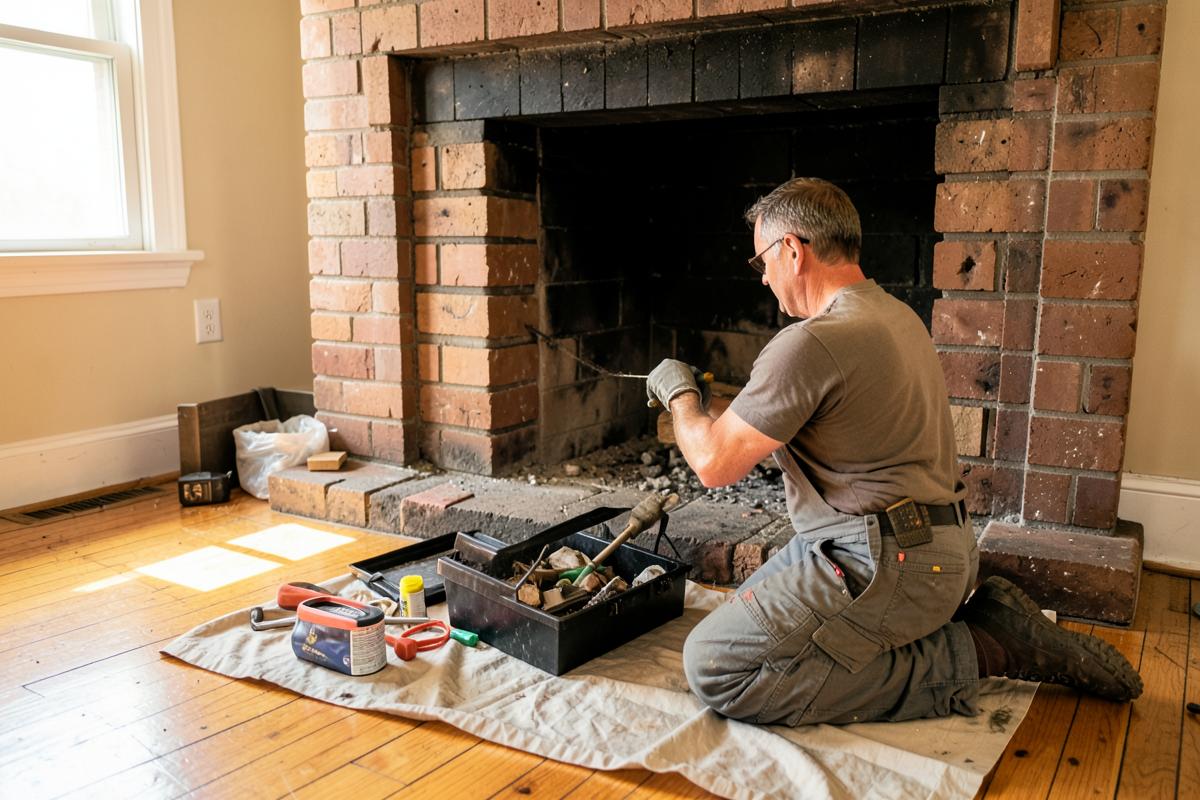
Fireplace faults are rarely mysterious once the components are looked at in order. Firebox panels crack, refractory mortar joints open, dampers seize, door gaskets flatten, and grates burn through. Each has a defined repair and a defined lifespan.
We diagnose before quoting, and we tell you which findings affect safety and which are cosmetic. That means you can decide what to do now and what can reasonably wait until next season.
What the visit includes
- Component-by-component fault diagnosis
- Firebox panel and refractory joint repair
- Damper, door and gasket repair or replacement
- Grate, screen and ash-dump component work
- Written summary separating safety from cosmetic items
Signs you need this
- Cracked or crumbling panels inside the firebox
- Smoke entering the room during normal use
- Doors that will not close or seal
- Soot staining on the wall above the opening
Areas we cover around Woodstock
Tavistock · Innerkip · Thamesford · Embro · Drumbo
A fireplace accumulates small failures the way any appliance used seasonally does: a damper that sticks a little more each year, a glass door gasket that has gone flat and brittle, a grate that has finally burned through at the same spot it always weakens first. None of these individually feel urgent, which is exactly why so many fireplaces end up with three or four minor faults stacked on top of each other by the time someone calls for a repair.
The value of a proper repair visit in Ontario is not just fixing the one thing you noticed — it is going through the whole assembly in order, because a damper that will not seal and a gasket that has failed often combine to waste far more heat and let far more smoke drift into the room than either would alone. Treating them as one visit rather than three separate future calls also saves on repeat trip charges.
We separate every finding into what affects safety and what is purely cosmetic or efficiency-related, because that distinction should drive your decision about what gets fixed now versus what can reasonably wait a season. A cracked firebox panel is not optional. A tarnished brass trim kit is entirely up to you.
The most common fireplace faults we diagnose
Damper problems top the list by volume: dampers seize from rust, warp from repeated heat cycling, or simply get bent by someone reaching in to adjust a log. A damper that will not close fully lets conditioned air escape up the flue year-round, which shows up as a higher heating and cooling bill long before anyone connects it to the fireplace.
Glass door and screen issues come next — gaskets flatten and stop sealing, hinges sag until the door no longer sits flush, and screen mesh eventually burns through from ember contact. These are rarely urgent on their own but compound efficiency loss when combined with a damper problem.
Grates and ash-dump components wear from direct heat and ember weight over years of use, eventually cracking or collapsing. None of these individually threaten the structure, but a collapsed grate can shift burning wood closer to the firebox opening than intended, which is worth fixing before it becomes an ember-spill incident rather than after.
- Damper seized, warped, or not sealing fully
- Glass door gasket flattened or hinges sagging
- Screen mesh burned through from ember contact
- Grate cracked, sagging, or burned through at the base
- Ash-dump door not seating or trapdoor mechanism seized
Diagnosing before quoting
We work through the fireplace component by component in a fixed order — firebox, damper, smoke chamber access, doors and screens, then hearth — because faults often have a common root cause that is only visible once you have looked at everything together. A damper that will not seal, for instance, sometimes traces back to a shifted smoke shelf rather than the damper hardware itself.
This diagnostic pass happens before any quoting, and it results in a written list separating safety findings from cosmetic ones. Homeowners consistently tell us this is the part they find most useful, because it lets them plan spending across a season rather than feeling pressured to fix everything on the spot.
That written list also tracks how faults interact with each other — a warped damper paired with a flattened door gasket, for example, gets explained as a single air-leakage problem rather than two unrelated line items, since fixing only one rarely resolves the drafty, smoky feeling that prompted the call in the first place. We would rather spend the extra few minutes explaining that connection than have you pay for a damper repair and still smell smoke in the room a month later.
Working with older and custom-built fireplaces
Fireplaces built before the 1980s, particularly custom masonry units poured or laid on-site rather than assembled from a factory kit, do not always match anything in a modern parts catalogue. A damper salvaged from an older build or a custom-cut grate made decades ago by a local ironworker has no equivalent part number to order, which means repair sometimes means having a component fabricated rather than simply purchased.
We measure and photograph the original hardware before recommending fabrication, and where a close manufactured equivalent exists at a fraction of the cost of a custom piece, we say so plainly rather than defaulting to the more expensive option out of convenience. Custom ironwork, when it is genuinely needed, typically adds one to two weeks to a repair timeline while the piece is made and fitted.
Older masonry fireboxes also sometimes reveal past repairs done with the wrong materials, parging compound instead of refractory mortar, or a patch of regular brick mortar troweled over a joint gap. We flag these openly, since they are often the actual reason a supposedly fixed fireplace develops the same complaint again within a year or two.
Materials and part sourcing
For factory-built fireplaces, every replacement part — glass panels, gaskets, dampers, control components — has to be sourced from the manufacturer's listed parts catalogue. Using a generic substitute might physically fit, but it voids the unit's certification and can affect insurance standing if something later goes wrong. We identify the model and search the correct parts list before ordering anything.
Masonry fireplace repairs use different materials depending on the component: cast iron or steel dampers rated for firebox temperatures, refractory-grade mortar for any joint repair inside the firebox itself, and standard hardware for doors and screens outside the direct heat zone. Mixing up which material belongs where is a common shortcut in lower-cost repairs that shows up as premature failure within a season or two.
Seasonal timing in Ontario
Fall is by far the busiest season for fireplace repair calls, as homeowners test their fireplace for the first time since spring and discover whatever failed quietly over the summer. Booking a repair visit in September or early October, before the cold snap arrives, generally means faster scheduling and more time to source any manufacturer-specific parts if the unit is a factory-built model.
Waiting until the first cold night to test a fireplace that has sat unused for six months is a common pattern, and it means any repair need surfaces at exactly the moment everyone else in the region is also calling for the same reason. Booking a mid-autumn check avoids being at the back of that queue.
Code and safety context for repairs
Damper and door repairs are generally straightforward maintenance items with no permit implications, but any repair touching the firebox lining, the smoke chamber, or clearances to combustible framing intersects with Ontario Building Code and WETT-referenced safety standards. Findings in that category get flagged distinctly because they affect whether the fireplace should be used until corrected.
A fireplace repair report is also something insurers occasionally ask to see, particularly after a claim involving smoke or fire damage nearby, or when a policy renewal specifically requests confirmation of fireplace condition. Keeping a written diagnostic record from a repair visit is useful documentation to have on file for that reason alone.
Repair versus replacement
Most of what we see repairs cleanly: dampers, doors, gaskets, grates and screens all have defined replacement parts and predictable costs. The threshold for recommending replacement of the whole appliance, rather than continued component repair, is usually when a factory-built unit's parts have become discontinued or when the firebox itself shows structural cracking beyond what refractory repair can address.
For an older factory-built fireplace, we will tell you plainly if repair costs are approaching what a new unit would cost, since patching an obsolete model with hard-to-source parts is sometimes false economy compared to replacing it outright.
What a repair finding means for resale
Buyers and their home inspectors routinely test the fireplace during a showing, and a damper that will not close or a door that will not seal are exactly the kind of small deficiency that ends up on a pre-purchase inspection list. Addressing these before listing avoids giving a buyer negotiating leverage over something inexpensive to fix.
Conversely, a fireplace with a recent written repair record showing components tested and working is a small but genuine positive in a listing package, particularly for buyers who plan to use the fireplace regularly rather than treat it purely as decor.
Fireplace Repair cost in Woodstock
A typical fireplace repair visit in Ontario runs between $400 and $800 once diagnosis and two or three component repairs are combined.
| Work | Typical range | What moves the price |
|---|---|---|
| Diagnostic visit with written findingsOften credited toward same-visit repair work | $150 – $220 | Often credited toward same-visit repair work |
| Damper repair or replacementHigher end for top-sealing or custom-sized dampers | $220 – $480 | Higher end for top-sealing or custom-sized dampers |
| Glass door gasket and hinge serviceDepends on whether hardware needs full replacement | $140 – $260 | Depends on whether hardware needs full replacement |
| Grate or ash-dump component replacementCustom-sized grates cost more than standard fits | $100 – $260 | Custom-sized grates cost more than standard fits |
| Factory-built unit parts replacementVaries widely by manufacturer and part availability | $250 – $700 | Varies widely by manufacturer and part availability |
| Combined multi-component repair visitTypical when several small faults are addressed together | $400 – $850 | Typical when several small faults are addressed together |
Ranges are estimates for planning only, not quotes. Final pricing depends on what we find on site, access, and the condition of the existing system.
What moves the price
- Whether the fireplace is masonry or factory-built
- Availability of manufacturer-listed replacement parts
- Number of components needing repair in one visit
- Whether the firebox itself needs refractory work
- Access difficulty for the damper or smoke chamber
- Age of the unit and whether parts are still in production
Want a number for your own fireplace? Send us the details and we will come back with an estimate, or call (833) 949-4153.
How the work goes, step by step
- 1
Full component diagnosis
We inspect the firebox, damper, smoke chamber access, doors, screens and hearth in a fixed sequence to catch faults that share a common cause rather than treating symptoms in isolation.
- 2
Written findings summary
Every issue found is documented and separated into safety findings and cosmetic or efficiency items, so you can decide what happens now versus what can wait.
- 3
Parts sourcing
For factory-built units we identify the exact model and pull from its listed parts catalogue; for masonry fireplaces we select the correct grade of hardware and refractory material for each location.
- 4
Component repair
Repairs proceed in order of priority, typically starting with anything affecting safe operation before moving to efficiency and cosmetic items in the same visit where parts are on hand.
- 5
Function testing
Dampers, doors and mechanisms are cycle-tested after repair to confirm they seal and operate correctly, not just that they look fixed.
- 6
Handover and documentation
You receive a written summary of what was repaired and what, if anything, is worth monitoring or scheduling for a future visit.
How long it takes: Most repair visits, including diagnosis, are completed in two to four hours; jobs requiring back-ordered manufacturer parts may need a return visit.
Looking after it afterwards
- Cycle the damper open and closed a few times each season to keep it moving freely
- Wipe down glass door gaskets before the burning season to check for flattening
- Keep the ash-dump door closed between cleanings to maintain proper draft
- Schedule an annual check even in years with no obvious complaint
- Note and report any new smoke smell or draft change promptly
Mistakes we see most often
- Forcing a stuck damper open rather than having it serviced
- Using a generic glass panel or gasket in a factory-built unit
- Ignoring a grate that has visibly sagged or cracked
- Waiting until the first cold night to test the fireplace each year
- Treating a firebox crack as cosmetic rather than a safety finding
Questions homeowners ask
- Can I use the fireplace while waiting for a repair?
- Not if the finding involves the firebox, the liner or a blockage. Those allow heat or gases to reach places they should not, and we will say clearly when that applies.
- Do you repair factory-built fireplaces?
- Yes, with manufacturer-listed replacement parts. Substituting generic parts in a listed appliance voids its certification.
- How do I know if a fireplace fault is safety-related?
- Anything involving the firebox lining, the smoke chamber, or a component that affects how smoke and heat are contained is treated as a safety finding. Doors, screens, and decorative hardware are generally cosmetic unless they are failing badly enough to affect sealing.
- Can I keep using the fireplace before a scheduled repair?
- It depends what was found. Damper and door issues usually just mean reduced efficiency, but any firebox, liner, or blockage finding means the fireplace should not be used until it is corrected, and we will say so clearly in the written summary.
- Why does my damper feel stuck every fall?
- Rust from summer humidity and a full season of heat cycling both contribute to seized dampers. A light service and lubrication at the start of each season usually prevents this from recurring.
- Are factory-built fireplace parts hard to find?
- It depends on the age and manufacturer. Units under about fifteen years old usually have good parts availability; older or discontinued models sometimes require sourcing through secondary suppliers, which we will flag if it affects your timeline.
- Will a repair report help with an insurance claim?
- It can. Insurers sometimes ask for documentation of fireplace condition after a related claim or at renewal, and a written repair record with dated findings is useful supporting evidence to have on file.
- Is it cheaper to repair or replace an old fireplace?
- Most component repairs are far cheaper than replacement. Replacement only becomes the sensible option when parts are discontinued or the firebox itself has structural damage beyond refractory repair, and we will tell you plainly if you are approaching that point.
- Can a very old or custom fireplace still be repaired?
- Usually yes, though parts sometimes need to be fabricated rather than ordered from a catalogue if the original hardware has no modern equivalent. We will tell you upfront if a custom piece is needed and roughly how much extra time that adds to the job.
- What if a previous repair was done with the wrong materials?
- We see this fairly often on older masonry fireboxes, usually regular mortar or filler used somewhere refractory-rated material was needed. We flag it as part of the diagnosis, since it is a common reason the same complaint returns even after a prior repair.
Nearby
Other Communities Near Woodstock
Related work
Often Booked Together
Fireplace Installation in Woodstock
New fireplace installation with correct venting, clearances and finished surround.
Insert Installation in Woodstock
Gas, wood and electric inserts fitted into existing masonry openings with proper liners.
Glass Doors in Woodstock
Custom-fitted glass doors that reduce heat loss and keep sparks in the firebox.
Mantel Installation in Woodstock
Mantel and surround installation with clearances that satisfy the appliance listing.