
Ontario Fireplace & Chimney Specialists
Fireplace Cleaning in Elora
A clean firebox is easier to inspect and much nicer to look at.
Every job starts with a proper look at your system — not a guess over the phone. You get a written quote before any work begins, a clear explanation of what we found, and a technician who works to manufacturer and code requirements from start to finish.
- Written quotes, no surprise charges
- Photo-backed findings after every visit
- Work performed to code and manufacturer specs
- Serving Elora and Wellington County, year-round
Fireplace Cleaning for Elora homes
Elora's stone houses along the Grand River gorge carry original masonry chimneys, many still serving open wood fireplaces or inserts added in later decades.
Gorge humidity and freeze-thaw work on exposed stone all winter, so crowns, caps and flashings are the first things we assess before looking at the appliance.
Soot, ash and firing residue accumulate on every surface in and around a firebox. Beyond appearance, that residue holds odour, and on gas appliances it changes how the flame behaves and how quickly glass films over.
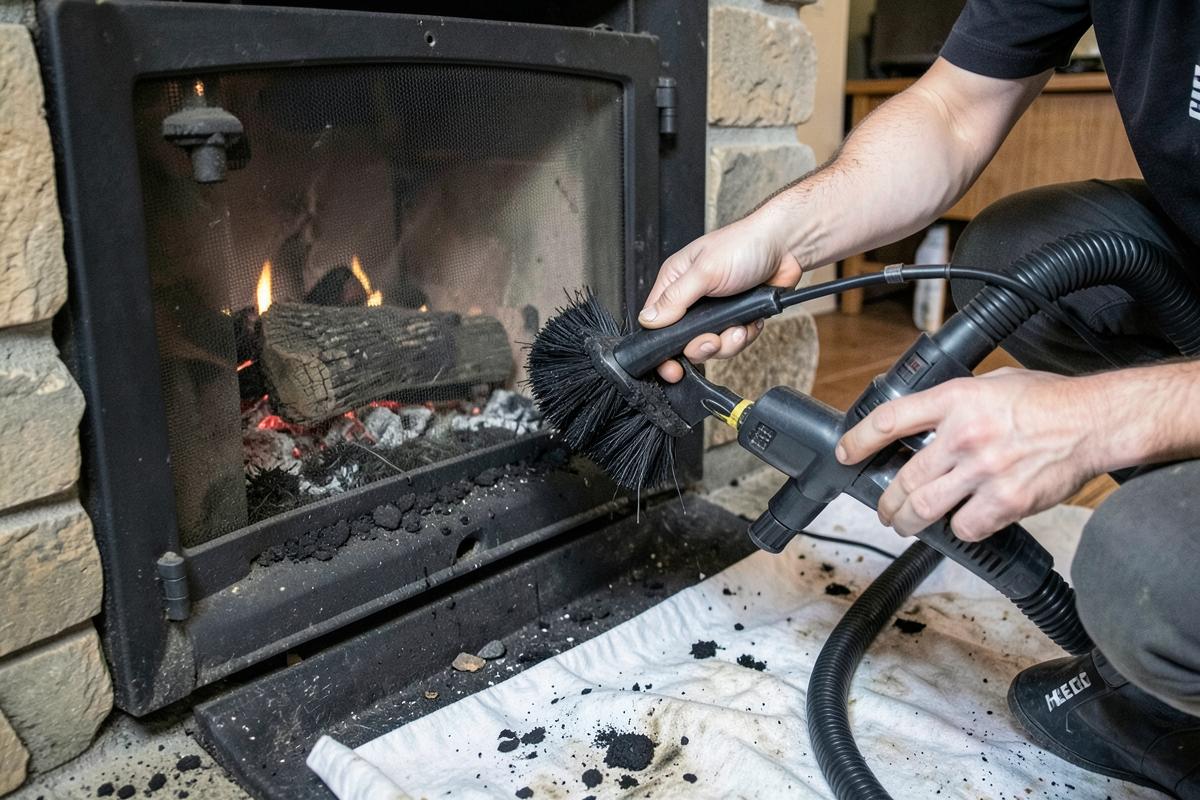
We vacuum the firebox with sealed containment, clean glass and gaskets with appropriate products, wash or replace log sets and embers where the manufacturer allows, and treat hearth stone and surround masonry without staining it.
What the visit includes
- Contained HEPA vacuuming of firebox and hearth
- Glass and gasket cleaning
- Log set, ember bed and screen cleaning
- Hearth stone and surround masonry treatment
- Ash dump and cleanout clearing
Signs you need this
- Heavy soot staining on the firebox or surround
- A hazy film on the glass that will not wipe off
- Discoloured or greyed log sets
- Ash spilling from a full cleanout
Areas we cover around Elora
Fergus · Alma · Salem · Ponsonby · West Montrose
Fireplace cleaning covers the parts of the system that chimney sweeping does not fully address: the firebox interior, hearth, glass doors or screens, and the visible masonry or metal surfaces that accumulate soot, ash dust and handling grime over a burning season. While a chimney sweep focuses on the flue itself, a fireplace cleaning focuses on the space where the household actually interacts with the appliance day to day.
For gas fireplaces, cleaning takes on a slightly different character, since there is no creosote to speak of but there is dust accumulation on logs and burner components, fingerprints and haze on glass fronts, and occasionally a light film from the combustion process that builds up on interior surfaces over months of regular use. A gas fireplace that looks dusty or has a hazy glass front is not necessarily unsafe, but it is a visible sign that a cleaning and service visit is due.
This page focuses on what a standalone or combined fireplace cleaning visit actually involves, how it differs from a full chimney sweep, and how often Ontario households should plan for it depending on how their fireplace gets used through the year.
What fireplace cleaning covers versus chimney sweeping
Chimney sweeping targets the flue interior from the damper up through the chimney top, removing creosote and soot buildup that poses a fire risk if left to accumulate. Fireplace cleaning targets everything below and around that: the firebox floor and walls, the hearth extension, glass doors or mesh screens, and any exposed brick or stone face that has picked up soot staining from years of use.
Many service visits bundle both together since a technician on site for one job can efficiently address the other, but they are functionally separate tasks addressing separate problems, one about flue safety and creosote risk, the other about appearance, ash management and surface upkeep.
Gas fireplace cleaning overlaps more with what is typically called a service visit, since cleaning the glass, dusting the logs and clearing the burner ports is usually done alongside a broader inspection of pilot function, ignition and venting rather than as a purely cosmetic task on its own.
Ash management for wood-burning fireplaces
A shallow bed of ash, roughly an inch deep, is actually beneficial for wood fires since it insulates the firebox floor and helps coals retain heat between logs, but ash allowed to build up much beyond that starts to interfere with airflow to the fire and can eventually crowd the grate or block the ash dump if one is present. Regular partial ash removal, leaving that thin insulating layer, is the practice most experienced wood burners follow.
Ash should always be assumed to hold live embers for at least a day or two after a fire appears out, and removed ash needs to go into a metal container with a lid, set on a non-combustible surface away from the house, never directly into a household trash bin, since ash fires from bins placed too soon after a fire are a recurring and entirely preventable cause of house fires.
Fireplaces with a built-in ash dump, a trap door in the firebox floor leading to a cleanout chamber below, still need that chamber periodically emptied from the basement or exterior cleanout door, since it is not a bottomless disposal system and can fill up over a season or more of regular use.
- Leave roughly an inch of ash as insulation rather than removing all of it
- Assume ash holds live embers for at least 24 to 48 hours after a fire
- Store removed ash in a lidded metal container outdoors on a non-combustible surface
- Empty ash dump cleanout chambers periodically rather than assuming unlimited capacity
Cleaning firebox brick, stone and glass
Firebox brick and firebrick develop a soot patina over time that is largely cosmetic and does not need aggressive removal, though homeowners who want a cleaner look can use a masonry-safe cleaner formulated for firebox use rather than household degreasers, which can leave residue that discolours further with the next fire. Firebrick in particular should never be cleaned with a wire brush aggressive enough to gouge the surface, since firebrick's integrity matters for heat resistance.
Glass doors and screens accumulate a sooty haze from wood burning that dedicated fireplace glass cleaner handles well, generally applied to cool glass and wiped with a soft cloth rather than paper towel, which can scratch the surface over repeated use. Gas fireplace glass develops a different kind of film, sometimes a white or grey haze from mineral deposits in the combustion process, that occasionally needs a specific glass conditioner treatment rather than standard soot-removal cleaner.
Exterior firebox surrounds, brick, stone or tile facing around the opening, generally need only occasional dusting or a damp wipe unless soot staining has become visible on the surface immediately around the opening, in which case the same masonry-safe cleaning approach used inside the firebox applies.
Gas fireplace cleaning and service overlap
A gas fireplace cleaning visit typically includes removing and dusting the ceramic logs or glass media, vacuuming dust from the burner assembly and pilot area, wiping down interior surfaces, and cleaning the glass front inside and out. This is usually paired with a functional check of pilot ignition, flame pattern and any visible venting issues, since a technician handling the glass and interior components is well positioned to notice something that needs attention functionally as well as cosmetically.
Manufacturers generally recommend this combined cleaning and service check on an annual basis for gas units in regular seasonal use, timed for early autumn before the unit goes into heavy winter service, similar in spirit to the timing recommendation for wood-burning chimney sweeps.
Seasonal timing for cleaning visits
Late summer through early autumn is the ideal window for a full fireplace cleaning, whether wood or gas, since it puts the appliance into its best condition right before the heaviest use period of the year begins, and it typically means shorter scheduling wait times than the rush that hits every chimney and hearth service company once the weather turns cold.
Households burning wood through a full winter season sometimes benefit from a mid-season firebox cleaning as well, particularly if ash has built up faster than expected or if glass doors have hazed over noticeably by mid-winter, though this is a matter of household preference rather than a strict requirement in the way flue sweeping frequency is.
DIY cleaning versus calling a professional
Basic ash removal and glass wiping between service visits is a reasonable DIY task for most homeowners, using a metal ash shovel, a lidded ash container, and a dedicated fireplace glass cleaner rather than improvised household products. Where DIY cleaning tends to fall short is in fully assessing whether soot staining, unusual residue, or a persistent smoky smell points to something beyond routine cleaning, such as a draft problem or an early creosote buildup issue that actually calls for a sweep rather than a cosmetic clean.
A professional cleaning visit also brings a HEPA-filtered vacuum setup that captures fine soot particulate far more effectively than a household shop vacuum, which matters for indoor air quality during the cleaning process itself, particularly for households sensitive to dust or with respiratory concerns.
Signs it is time to book a cleaning visit
A visibly thick ash bed crowding the grate, glass doors hazed enough to obscure the flame view, soot staining creeping onto the surrounding brick or stone face, or simply the arrival of early autumn before the heating season ramps up are all reasonable triggers to book a cleaning visit. For gas units, a burner that looks dusty, a pilot flame that looks uneven, or a glass front with visible film are the equivalent signals.
None of these signs necessarily indicate an unsafe condition on their own, but they are the kind of visible cues that make a cleaning and, where relevant, a combined inspection worth scheduling before the appliance goes into its next heavy-use stretch.
Fireplace Cleaning cost in Elora
A standalone firebox and glass cleaning visit typically runs $140 to $220, while combining it with a chimney sweep or gas service visit brings the total closer to $260 to $380.
| Work | Typical range | What moves the price |
|---|---|---|
| Standard wood firebox cleaningash removal, glass cleaning and surface wipe-down | $120 – $200 | ash removal, glass cleaning and surface wipe-down |
| Firebox cleaning bundled with chimney sweepcombined visit covering flue, firebox and hearth | $260 – $380 | combined visit covering flue, firebox and hearth |
| Gas fireplace glass and interior cleaninglog dusting, burner vacuuming and glass detailing | $140 – $220 | log dusting, burner vacuuming and glass detailing |
| Gas fireplace cleaning bundled with annual servicecombined cleaning and functional service check | $220 – $380 | combined cleaning and functional service check |
| Masonry face soot staining treatmentfor visible staining on brick or stone around the opening | $150 – $300 | for visible staining on brick or stone around the opening |
| Ash dump cleanout chamber emptyingaccessing and clearing the below-grade or exterior cleanout | $100 – $180 | accessing and clearing the below-grade or exterior cleanout |
Ranges are estimates for planning only, not quotes. Final pricing depends on what we find on site, access, and the condition of the existing system.
What moves the price
- Whether cleaning is bundled with a chimney sweep or gas service visit
- Amount of ash and soot buildup found at the time of the visit
- Whether glass doors or screens need detailing in addition to the firebox
- Condition of the surrounding masonry or tile face
- Whether an ash dump cleanout chamber needs to be accessed and emptied
- Number of fireplaces cleaned in the same visit
Want a number for your own fireplace? Send us the details and we will come back with an estimate, or call (833) 949-4153.
How the work goes, step by step
- 1
Protect the surrounding area
Drop cloths are placed around the hearth and adjacent flooring before any ash or soot is disturbed.
- 2
Remove ash and debris
Ash is cleared from the firebox floor, leaving a thin insulating layer where appropriate, and bagged or containered for disposal.
- 3
Vacuum firebox surfaces
A HEPA-filtered vacuum clears fine soot dust from the firebox walls, floor and any visible ledges.
- 4
Clean glass and screens
Glass doors or mesh screens are wiped down with appropriate cleaner to remove sooty haze or, for gas units, mineral film.
- 5
Wipe surrounding masonry or tile
The visible brick, stone or tile face around the opening is dusted or treated for any soot staining present.
- 6
Final check and disposal
Removed ash and debris are placed in appropriate containers for safe disposal, and the area is left clean.
How long it takes: A standalone fireplace cleaning visit typically takes thirty to sixty minutes; combined visits with a sweep or gas service take longer depending on flue condition.
Looking after it afterwards
- Continue removing excess ash regularly rather than letting it build up between visits
- Store ash in a lidded metal container outdoors, never in household trash
- Wipe glass doors periodically with dedicated cleaner between full service visits
- Watch for soot staining creeping onto surrounding brick or tile as an early sign more frequent cleaning is needed
- Schedule the next cleaning before the following heating season begins
Mistakes we see most often
- Disposing of ash in a plastic bin or household trash bag before it has fully cooled
- Using household glass cleaner instead of a dedicated fireplace glass product
- Scrubbing firebrick aggressively enough to damage its surface
- Letting ash build up until it interferes with the grate or airflow
- Assuming a clean-looking firebox means the flue itself does not need sweeping
Questions homeowners ask
- Is cleaning the same as sweeping?
- No. Cleaning addresses the firebox and the visible parts; sweeping addresses the flue. Wood-burning systems need both.
- Can I clean gas fireplace glass myself?
- Carefully, once cool and only with a cleaner rated for fireplace glass. Ammonia products and abrasives can permanently haze the surface.
- Is fireplace cleaning the same as chimney sweeping?
- No, chimney sweeping addresses creosote and soot buildup inside the flue itself, while fireplace cleaning addresses the firebox, hearth, glass and surrounding surfaces, and while the two are often bundled into one visit for convenience, they address different parts of the system and different risks.
- How much ash should be left in a wood-burning firebox?
- A thin layer of roughly an inch is generally left in place because it insulates the firebox floor and helps coals hold heat, while ash allowed to build up much beyond that starts to interfere with airflow and can crowd the grate or block an ash dump opening.
- Can gas fireplace glass be cleaned with regular household glass cleaner?
- Standard glass cleaner can sometimes leave streaking or fail to fully remove the specific film that gas combustion produces on interior glass, so a dedicated fireplace glass cleaner or conditioner is generally more effective and reduces the risk of residue that becomes more visible once the fireplace is running again.
- How often should a gas fireplace be cleaned?
- Most manufacturers recommend an annual cleaning and service check for gas fireplaces in regular seasonal use, ideally scheduled in late summer or early autumn before the heaviest use period of the year begins.
- Is it safe to vacuum fireplace ash with a regular household vacuum?
- A regular household vacuum is not well suited to fine ash and soot particulate, since it can clog the filter quickly and may push fine dust back into the room air rather than containing it, which is why a HEPA-filtered vacuum designed for ash and soot is the more effective and safer choice.
- What does soot staining on the brick around the firebox opening indicate?
- Visible soot staining spreading onto the brick or stone face around the opening is often simply a sign of regular use accumulating over time, though a sudden increase in staining can also indicate a draft problem worth having assessed alongside the cleaning visit.
Nearby
Other Communities Near Elora
Related work
Often Booked Together
Fireplace Repair in Elora
Diagnosis and repair of fireboxes, dampers, doors, screens and hearth components.
Fireplace Installation in Elora
New fireplace installation with correct venting, clearances and finished surround.
Insert Installation in Elora
Gas, wood and electric inserts fitted into existing masonry openings with proper liners.
Glass Doors in Elora
Custom-fitted glass doors that reduce heat loss and keep sparks in the firebox.