Ontario Fireplace & Chimney Specialists
Fireplace Childproofing in Perth
Glass fronts reach burn temperatures in minutes and stay hot long after shutdown.
Every job starts with a proper look at your system — not a guess over the phone. You get a written quote before any work begins, a clear explanation of what we found, and a technician who works to manufacturer and code requirements from start to finish.
- Written quotes, no surprise charges
- Photo-backed findings after every visit
- Work performed to code and manufacturer specs
- Serving Perth and Lanark County, year-round
Childproofing for Perth homes
Perth's stone architecture is among the best preserved in eastern Ontario, and its chimneys were laid in lime mortar that modern hard mixes will damage.
We match mortar to the original and reline rather than rebuild wherever possible, keeping heritage masonry intact while making the flue safe for a current appliance.
A gas fireplace glass front can exceed 200°C within minutes and stays dangerous for a long time after the flame is out. Many units installed before barrier screens became standard have nothing between that glass and a curious toddler.
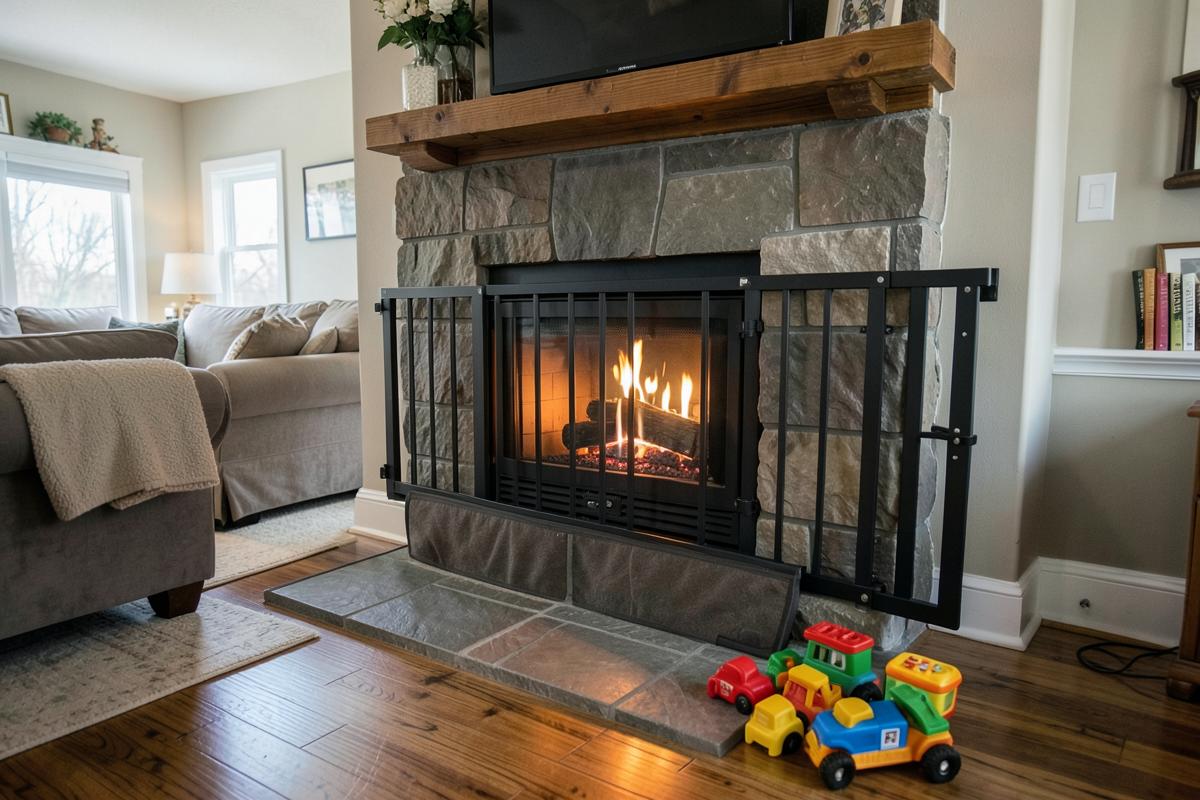
We fit manufacturer-matched barrier screens where they exist, add a free-standing hearth gate where they do not, pad raised hearth edges and corners, and lock or relocate wall controls and remotes.
What the visit includes
- Surface temperature assessment
- Manufacturer barrier screen retrofit where available
- Free-standing hearth gate options
- Hearth edge and corner protection
- Control, switch and remote locking
Signs you need this
- A crawling or walking child in the home
- A glass-front unit with no barrier screen
- A raised hearth with sharp stone edges
- Wall switches within a child's reach
Areas we cover around Perth
Smiths Falls · Balderson · Lanark · Westport · Maberly
A wood or gas fireplace introduces hazards to a household with young children that go beyond the obvious risk of an open flame: a hot glass door on a gas unit can retain surface temperatures high enough to cause a serious burn on contact for many minutes after the flame is turned off, sharp hearth corners sit at exactly toddler head height, and fireplace tools, a poker or a bag of fire starters left within reach are an invitation for exploration. Childproofing a fireplace means addressing all of these separately rather than assuming a single barrier solves everything.
Ontario families dealing with this often discover the issue only after a close call, a toddler reaching toward a glowing glass panel or catching a hip on a stone hearth corner, and end up researching solutions under some time pressure. A calmer, more thorough approach considers the specific fireplace type, the layout of the room, and the age and mobility of the children involved, since a solution appropriate for a crawling infant looks different from what an active four-year-old needs.
This page walks through the specific hazards different fireplace types present, the physical barriers and modifications available, and how to balance safety with keeping a wood or gas fireplace usable and attractive during the years a barrier is needed.
Understanding what actually needs to be addressed
The most underappreciated hazard with a gas fireplace is surface temperature on the glass front, which on many units remains hot enough to cause a contact burn for fifteen to forty-five minutes after the flame has been switched off, well after a child or even an adult would assume the unit had cooled. Wood-burning fireplaces present the more obvious hazard of an open flame and hot embers, along with a hearth surface, whether stone, brick or tile, that heats up during and after a fire.
Beyond the fire itself, tool sets, matches, lighters and fire starter materials are common secondary hazards, since they are often stored at low, easily reached heights right beside the fireplace for convenience during normal use. Hearth edges and mantel corners present a physical impact hazard independent of whether a fire is burning at all, relevant any time a mobile child is in the room.
A complete childproofing plan addresses each of these categories rather than treating a single gate as sufficient, since a gate around the hearth does nothing to protect a curious hand reaching between the bars toward a hot glass panel, and corner guards do nothing to keep matches out of reach.
Grandparents' houses and vacation properties visited only occasionally deserve the same attention as a primary residence, since a child who has learned the household rules around their own fireplace at home may not automatically transfer that caution to an unfamiliar hearth in a different layout, and a lapse in supervision during a visit is just as consequential as one at home.
- Surface temperature of gas fireplace glass fronts after the flame is off
- Open flame and ember exposure on wood-burning units
- Hearth and mantel corner impact hazards
- Accessible storage of tools, matches, lighters and starter materials
Physical barrier options for the hearth opening
Freestanding hearth gates, similar in concept to a stair gate but sized and shaped to wrap around a fireplace opening, are the most common solution and come in heat-resistant materials rated to sit reasonably close to an operating fireplace without the gate itself becoming a hazard. These need to be tall enough that a climbing toddler cannot easily scale them and sturdy enough that a determined push does not topple the barrier toward the fire.
Custom-built barriers, sometimes fabricated from heat-resistant mesh panels mounted into a more permanent frame, offer a tidier long-term appearance for families who know they will need a barrier for several years, though they cost considerably more than an off-the-shelf freestanding gate and take more effort to remove and store once no longer needed.
Whatever barrier style is chosen, spacing between bars or mesh openings needs to be small enough that fingers cannot reach through to touch a hot glass surface, which is a common gap in cheaper or improperly sized gate products marketed generically for baby-proofing rather than specifically rated for fireplace use.
Glass front temperature-reducing options for gas units
Some gas fireplace manufacturers offer an optional secondary safety screen or barrier specifically designed to be installed in front of the main glass panel, maintaining a cooler surface temperature on the child-facing side while still allowing the fireplace to operate and be viewed normally. These are worth asking about directly with the appliance manufacturer or a service provider familiar with the specific model, since not every gas fireplace has a compatible accessory available.
Where no manufacturer accessory exists for a particular model, a physical barrier gate positioned to keep children at a safe distance from the glass front remains the most practical fallback, combined with consistent supervision and never leaving a young child unattended in a room with an operating gas fireplace regardless of what barrier is in place.
Hearth and mantel edge protection
Corner and edge guards made from dense foam or rubber, sized to fit the specific dimensions of a hearth ledge or mantel corner, reduce injury severity from an impact without requiring any permanent modification to the fireplace surround itself. These products need to be measured and fitted to the actual hearth profile, since generic table-corner guards sold for coffee tables often do not fit the wider, lower profile typical of a stone or brick hearth properly.
For families willing to consider a more permanent solution, some hearth surrounds can be modified with a padded cushioned edge trim installed along exposed corners, which stays in place more securely than adhesive foam guards but requires professional installation to avoid damaging the surrounding stone or tile finish.
- Foam or rubber corner guards fitted to actual hearth dimensions
- Padded edge trim for a more permanent, secure installation
- Regular inspection of adhesive guards to ensure they remain firmly attached
Storage and habit changes around the fireplace
Fireplace tool sets, typically including a poker, brush and shovel, should be relocated to a location genuinely out of reach rather than left in their usual stand beside the hearth, since these tools are frequently the exact height and reach that makes them attractive to a curious toddler. Matches, lighters, and any fire starter cubes or gel should be stored in a locked cabinet well away from the fireplace area entirely, following the same standard applied to other household chemical and combustion hazards.
Households that keep firewood in an indoor rack near the fireplace should also consider whether the rack itself, along with any loose bark or debris on the floor around it, presents a slipping or climbing hazard for a mobile toddler using it as a step toward the hearth.
Balancing safety with usability
A barrier that is so restrictive it discourages the family from using the fireplace at all defeats some of the purpose of having one, so it is worth choosing a solution that can be adjusted or temporarily moved for supervised use, such as a gate with a lockable door section that allows an adult to tend the fire without removing the entire barrier. Families who plan to use the fireplace regularly through the childproofing years often find a semi-permanent gate with an access door more practical than one that has to be fully disassembled every time.
It is also worth revisiting the barrier setup periodically as a child grows, since a barrier appropriate for a crawling infant may be inadequate once that same child is climbing furniture at eighteen months, and reassessing the setup every six months to a year through the early years keeps the protection matched to actual developmental stage.
Professional versus DIY approaches
Many childproofing measures, such as installing an off-the-shelf gate or fitting adhesive corner guards, are reasonable for a capable homeowner to handle without professional help. Custom barrier fabrication, modifications involving the fireplace surround itself, or questions about a specific gas unit's available safety accessories are better handled with input from a fireplace service professional familiar with the exact appliance model and its manufacturer-approved options.
A professional visit focused on childproofing typically also serves as a useful opportunity to have the fireplace's general condition checked at the same time, since a family newly focused on safety around the fireplace is often also a good candidate for confirming the unit itself is operating and venting correctly.
Fireplace Childproofing cost in Perth
A complete childproofing package for a typical single fireplace usually runs between $350 and $650 depending on barrier style chosen.
| Work | Typical range | What moves the price |
|---|---|---|
| Standard heat-resistant freestanding hearth gate, supplied and installedsized to a typical single fireplace opening | $220 – $380 | sized to a typical single fireplace opening |
| Custom-built mesh barrier with framed mountingtailored to unusual hearth dimensions or layout | $500 – $900 | tailored to unusual hearth dimensions or layout |
| Hearth and mantel corner guard set, fittedmeasured and fitted to the specific hearth profile | $80 – $160 | measured and fitted to the specific hearth profile |
| Padded permanent edge trim installationmore durable alternative to adhesive foam guards | $200 – $400 | more durable alternative to adhesive foam guards |
| Gas fireplace secondary safety screen, where availablemanufacturer-specific accessory, availability varies by model | $150 – $350 | manufacturer-specific accessory, availability varies by model |
| Combined childproofing consultation and installation visitgate, corner guards and storage recommendations addressed together | $300 – $600 | gate, corner guards and storage recommendations addressed together |
Ranges are estimates for planning only, not quotes. Final pricing depends on what we find on site, access, and the condition of the existing system.
What moves the price
- Fireplace opening size and hearth dimensions requiring a custom versus standard gate
- Whether a manufacturer-specific glass safety screen exists for the appliance model
- Number of exposed hearth or mantel corners requiring guards
- Choice between adhesive foam guards and more permanent padded trim
- Whether a gate with a lockable access door is preferred over a simple barrier
- Combined visit scope if a general fireplace condition check is bundled in
Want a number for your own fireplace? Send us the details and we will come back with an estimate, or call (833) 949-4153.
How the work goes, step by step
- 1
Household assessment
The fireplace type, room layout and children's ages and mobility levels are reviewed to determine which hazards need priority attention.
- 2
Barrier selection
A gate style is chosen based on hearth dimensions, desired durability, and whether supervised access through a lockable door is wanted.
- 3
Corner and edge measurement
Exposed hearth and mantel corners are measured for properly fitted guard or trim products rather than generic sizing.
- 4
Installation
The gate is secured in position, corner guards or trim are fitted, and stability is tested against a reasonable push or lean force.
- 5
Storage review
Tool sets, matches and starter materials in the area are identified and relocation recommendations are provided.
- 6
Follow-up check
A brief review after installation confirms the barrier remains secure and properly positioned once the household resumes normal use of the space.
How long it takes: A standard gate and corner guard installation typically takes one to two hours to measure, fit and secure properly.
Looking after it afterwards
- Check gate stability periodically as a child becomes more mobile and stronger
- Reassess the barrier setup every six months to a year as developmental stages change
- Keep tools, matches and starter materials in their new, out-of-reach storage location consistently
- Inspect adhesive corner guards regularly to confirm they remain firmly attached
- Never rely on a barrier alone as a substitute for supervision near an operating fireplace
Mistakes we see most often
- Assuming a generic baby gate not rated for heat is safe near an operating fireplace
- Leaving fireplace tools in their usual reachable position after installing a hearth gate
- Choosing bar spacing wide enough for small fingers to reach through toward hot glass
- Treating a barrier as a substitute for supervision rather than a supplement to it
- Not reassessing the setup as a child grows more mobile and capable of climbing
Questions homeowners ask
- Is a barrier screen available for my unit?
- Many manufacturers offer a retrofit kit for units built after the mid-2010s. Where none exists, a free-standing gate is the reliable alternative.
- How long does the glass stay hot?
- Often well over half an hour after shutdown, which is why a physical barrier beats supervision alone.
- Should visiting grandchildren change how a household childproofs its own fireplace?
- Households that only occasionally have young children visiting sometimes choose a simpler, quickly deployable barrier they can put up before a visit rather than a permanent fixture, though for frequent visits a semi-permanent gate with a lockable access door tends to be more reliable than something assembled in a hurry each time.
- Are there specific products recommended for multi-generational households?
- Households with both young children and older adults using the same living space sometimes need a barrier that is easy for an adult with mobility limitations to step over or open, so it is worth considering ease of everyday use alongside pure child-safety criteria when selecting a gate style.
- How hot does gas fireplace glass actually get?
- Surface temperatures on many gas fireplace glass fronts can exceed levels capable of causing a serious burn within seconds of contact, and that heat can persist for a significant period after the flame is turned off, which is why a barrier addressing glass contact specifically is important beyond just flame protection.
- Is a standard retail baby gate sufficient for fireplace use?
- Generally no, since standard gates are designed for stairways and doorways rather than proximity to radiant heat, and they are not rated or tested for the temperatures and clearances relevant to an operating fireplace, so a heat-rated, fireplace-specific product is the safer choice.
- At what age can childproofing measures typically be removed?
- This varies by child and household, but many families keep some form of barrier in place until a child reliably understands and respects the hazard, often well into the preschool years, rather than removing it at a fixed age.
- Do wood-burning fireplaces need different childproofing than gas units?
- The core barrier need is similar, but wood-burning fireplaces add hot ember and ash hazards that persist even after visible flames die down, along with hearth surfaces that retain heat for longer, so the supervision standard around a wood fire should be at least as cautious as with a gas unit.
- Can corner guards damage a stone or tile hearth surface?
- Properly fitted adhesive guards designed for the material generally do not damage the surface, though it is worth checking the specific adhesive type against the hearth material and testing on a small inconspicuous area first if there is any concern about staining or residue.
- Should the fireplace simply not be used at all while children are young?
- That is a valid choice some families make, but many households successfully continue using their fireplace with proper barriers, consistent storage habits and active supervision, so avoiding use entirely is a personal preference rather than a strict necessity.
Nearby
Other Communities Near Perth
Related work
Often Booked Together
Fireplace Repair in Perth
Diagnosis and repair of fireboxes, dampers, doors, screens and hearth components.
Fireplace Installation in Perth
New fireplace installation with correct venting, clearances and finished surround.
Insert Installation in Perth
Gas, wood and electric inserts fitted into existing masonry openings with proper liners.
Glass Doors in Perth
Custom-fitted glass doors that reduce heat loss and keep sparks in the firebox.