
Ontario Fireplace & Chimney Specialists
Firebox Repair in St. Thomas
The firebox is the one part where cracks are never cosmetic.
Every job starts with a proper look at your system — not a guess over the phone. You get a written quote before any work begins, a clear explanation of what we found, and a technician who works to manufacturer and code requirements from start to finish.
- Written quotes, no surprise charges
- Photo-backed findings after every visit
- Work performed to code and manufacturer specs
- Serving St. Thomas and Elgin County, year-round
Firebox Repair for St. Thomas homes
St. Thomas has a deep stock of railway-era brick housing, and its chimneys typically hold clay tile that has been in service for a century or more.
Cracked and spalling tile is common at this age, and camera inspection is the only reliable way to document it before recommending a liner.
The firebox contains the fire and separates it from the framing behind it. Cracks wider than a few millimetres, missing mortar joints and eroded firebrick all provide a heat path outward, which is why they are treated as a safety finding rather than a wear item.
Repair depends on the construction. Masonry fireboxes get individual firebrick replacement and refractory mortar repointing. Factory-built units take manufacturer-listed refractory panels, replaced as an assembly so the listing stays valid.
What the visit includes
- Crack mapping and depth assessment
- Individual firebrick replacement in masonry boxes
- Refractory mortar repointing to full joint depth
- Listed refractory panel replacement in factory-built units
- Hearth extension and clearance verification
Signs you need this
- Cracks in the firebox wider than a coin edge
- Missing mortar between firebricks
- Firebrick faces flaking or sounding hollow
- Discoloured or warm wall behind the fireplace
Areas we cover around St. Thomas
Port Stanley · Union · Sparta · Talbotville · Belmont
The firebox is the one part of a fireplace where a crack is never just cosmetic, because its entire job is to contain direct flame contact and keep that heat away from the wood framing sitting inches behind it. A hairline crack in a decorative brick surround somewhere else in the house is a patch job. The same crack inside a firebox is a heat path outward, and that distinction is why firebox findings get treated with more urgency than almost anything else in a fireplace inspection.
Firebox construction falls into two broad categories that repair completely differently: traditional masonry fireboxes built from individual firebrick and refractory mortar, and factory-built metal fireplaces lined with prefabricated refractory panels. Knowing which one you have determines whether the fix is a bricklaying job measured in individual joints or a panel-replacement job measured in manufacturer part numbers.
Either way, the goal of a firebox repair is restoring a continuous, intact barrier between the fire and everything behind it, not just making the surface look presentable again. A repair that looks fine but leaves a gap behind the visible brick face has fixed nothing that actually matters.
How masonry firebox damage develops
Firebrick and refractory mortar are engineered to expand and contract with direct flame heat, but that cycling still causes gradual wear over years of use. Mortar joints erode first because mortar is inherently more porous than the brick itself, and once a joint has opened even a few millimetres, heat and combustion gases have a route into the wall cavity behind the firebox.
Firebrick faces themselves crack less often than joints fail, but when they do it is usually from a specific event — a log dropped directly against the wall, an over-fired load of wood burning far hotter than the box was designed for, or years of moisture intrusion from a damaged crown weakening the brick from behind. Each cause leaves a slightly different crack pattern, which is part of what we document during assessment.
Left alone, deteriorating joints accelerate quickly once they start, because each opened joint lets more heat reach the next joint's mortar and speeds its failure too. A firebox that looked fine two seasons ago can show significant joint loss by the third, which is why firebox condition is checked at every annual sweep rather than only when a problem is reported.
How factory-built firebox panels fail
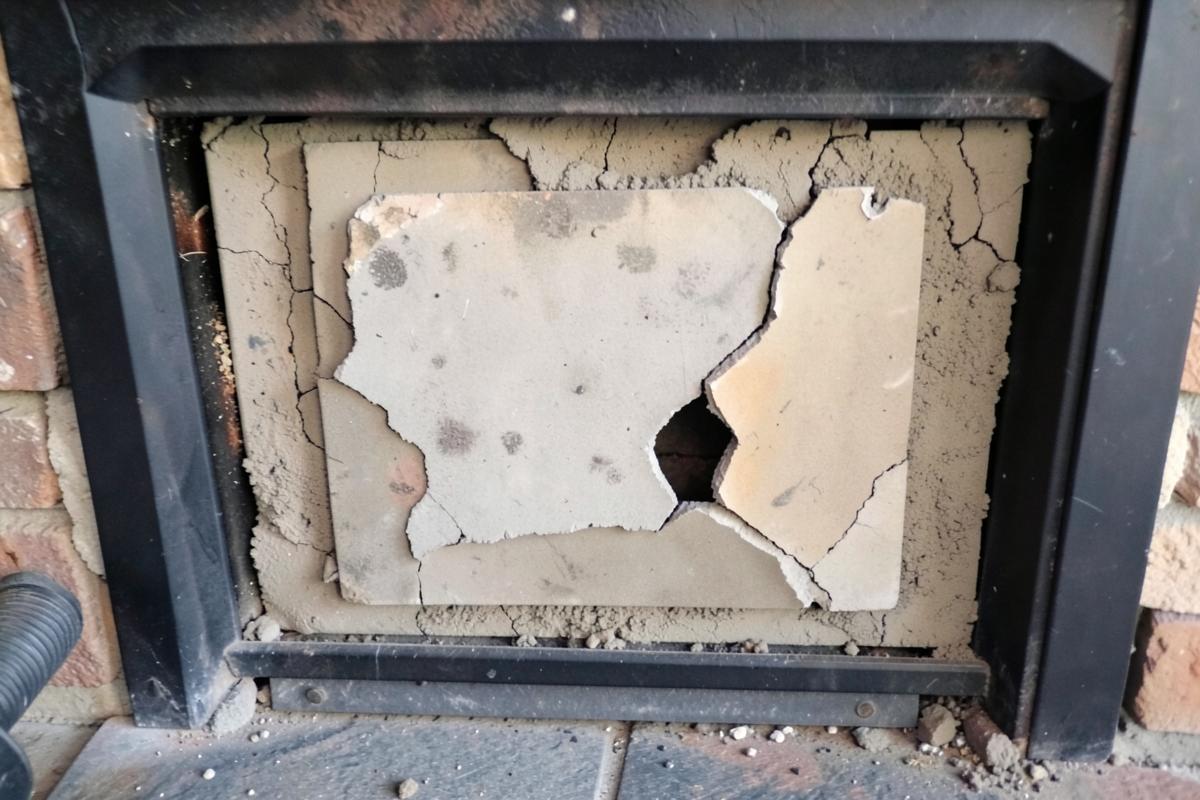
Factory-built fireplaces use refractory panels — a cement-based board engineered to the manufacturer's exact specifications for that model — lining the metal firebox shell. These panels crack from age, from thermal shock when cold outside air hits a hot panel, or from impact damage during a log placement or cleaning.
Unlike masonry, these panels cannot be patched with mortar or filler. They are replaced as a listed assembly using the manufacturer's specified part, because the unit's certification depends on the exact refractory material and thickness originally tested with that model. Substituting a generic panel, even one that looks identical, voids that certification.
Finding the correct replacement panel starts with identifying the model and manufacturer from the data plate, usually located inside the firebox or behind a lower access panel. For older or discontinued models, sourcing can take longer, which is worth knowing before assuming a firebox repair is a same-day fix.
Assessment and crack mapping
We map every crack and joint gap in the firebox before quoting, noting width, depth and location, because not every visible line is equally serious. A superficial surface crack in a firebrick face that has not penetrated the brick is a different finding than a joint gap running the full depth between two courses. Depth is checked with a probe rather than judged by eye, since surface appearance alone can be misleading.
This mapping also determines whether repair can be done in place or whether the extent of deterioration calls for a fuller rebuild of the affected wall section. A firebox with isolated joint failure in one or two spots is a repointing job; one with widespread brick face erosion across multiple walls usually needs more extensive brick replacement to hold a repair reliably.
We photograph every mapped crack and joint gap before beginning any work, both for our own before-and-after record and so you have documentation of the condition the firebox was in prior to repair. This becomes useful later if a question ever comes up about what was found versus what was addressed, particularly on a firebox with several pre-existing issues traceable to different causes.
- Crack width and depth measured with a probe, not judged visually
- Joint gaps checked for full-depth penetration
- Firebrick faces checked for flaking, hollow sound, or heat discolouration
- Wall temperature behind the firebox checked for heat transfer signs
- Factory-built units identified by model for correct panel sourcing
Materials: refractory versus standard products
Every material used inside a firebox has to be rated for direct flame contact, which standard construction materials are not. Refractory mortar, refractory-grade firebrick, and manufacturer-specified panel board all handle sustained high heat without breaking down the way regular mortar or drywall would within a single heavy burn.
This is worth stating plainly because ordinary mortar patch jobs on fireboxes are a repair we see fail within a season, sometimes done by a previous owner or a general contractor without fireplace-specific experience. Regular mortar simply cannot survive firebox temperatures long-term, and a repair using it needs to be redone properly rather than topped up again.
Ontario seasonal and moisture factors
Freeze-thaw cycling is a major contributor to firebox deterioration in this climate, particularly where a damaged chimney crown or cap has let moisture into the flue and firebox area from above. Water that gets behind firebrick and then freezes expands and pushes joints apart from the inside, which is why we always check the crown and cap condition as part of any firebox assessment rather than looking only at the visible interior.
Repairs completed in cold weather also need enough cure time before the firebox is used again, since refractory mortar needs to set properly rather than being rushed by an early fire. We will always specify a minimum cure period before your first use following a repair.
Chimney fires and their effect on firebox condition
A chimney fire, even a small, contained one a homeowner may not have reported at the time, routinely leaves cracking or spalling in the firebox and lower flue that would not otherwise appear from ordinary use. The sudden, extreme heat of burning creosote deposits is well beyond what normal wood-fire combustion produces, and firebrick or refractory panels rated for standard use can crack under that kind of thermal shock even if they show no other signs of age.
Any fireplace with a known or suspected prior chimney fire gets a more thorough firebox assessment as a matter of course, checking not just the visible brick face but probing joints more extensively than a routine inspection would, since damage from a chimney fire is not always confined to the area that looks obviously affected.
If you are not certain whether your chimney has ever had a fire, warning signs include a popping or roaring sound dismissed as normal fire noise at the time, a strong hot odour that lingered afterward, or fused, glassy-looking creosote found later inside the flue. Any of these histories is worth mentioning during a firebox assessment even years afterward.
Code, safety and when repair becomes rebuild
Firebox integrity sits at the centre of fireplace safety standards referenced by the Ontario Building Code and WETT-based inspection protocols, because it is the primary barrier preventing fire from reaching combustible framing. Any finding of full-depth joint failure or a heat-affected wall behind the firebox is treated as a use-restricting finding until repaired, not a maintenance note to schedule at leisure.
The line between repair and full rebuild is usually crossed when deterioration has spread across enough of the firebox that individual repointing would leave more new joints than old, structurally sound ones. At that point rebuilding the affected wall section fresh gives a more durable and often more cost-effective result than patchwork repointing spread over multiple visits.
Insurance and resale considerations
A documented firebox repair is meaningful paperwork for both insurance and resale purposes, since firebox condition is one of the first things a home inspector or insurer's fireplace assessor checks. A firebox with visible cracking that has gone unaddressed can affect a homeowner's insurance renewal in some cases, particularly if the fireplace is actively used.
For resale, unresolved firebox cracking is a near-certain item on a buyer's inspection report, and addressing it before listing avoids that becoming a negotiating point. A written repair record showing the work was done to code with appropriate materials is worth keeping with your other home documentation.
Firebox Repair cost in St. Thomas
Most firebox repairs in Ontario average $600 to $1,400, with full rebuilds running higher depending on the extent of deterioration.
| Work | Typical range | What moves the price |
|---|---|---|
| Crack mapping and firebox assessmentOften credited toward repair if booked together | $180 – $260 | Often credited toward repair if booked together |
| Refractory mortar repointing, per sectionDepends on number of joints affected | $300 – $600 | Depends on number of joints affected |
| Individual firebrick replacementPer brick, materials and labour | $40 – $80 | Per brick, materials and labour |
| Factory-built refractory panel replacementVaries by manufacturer and panel availability | $350 – $900 | Varies by manufacturer and panel availability |
| Partial firebox wall rebuildFor widespread joint or brick failure in one wall | $900 – $1,800 | For widespread joint or brick failure in one wall |
| Full firebox rebuildTypically one to two days plus mortar cure time | $1,800 – $3,500 | Typically one to two days plus mortar cure time |
Ranges are estimates for planning only, not quotes. Final pricing depends on what we find on site, access, and the condition of the existing system.
What moves the price
- Masonry versus factory-built firebox construction
- Number and depth of joints or cracks requiring repair
- Availability of the correct manufacturer panel for factory-built units
- Whether moisture intrusion from the crown has caused hidden damage
- Extent of firebrick replacement needed versus repointing alone
- Cure time required before the fireplace can be used again
Want a number for your own fireplace? Send us the details and we will come back with an estimate, or call (833) 949-4153.
How the work goes, step by step
- 1
Visual and probe inspection
Every crack and joint is examined and probed to determine depth and whether it fully penetrates the firebox wall, rather than relying on surface appearance alone.
- 2
Crown and cap check
We check for moisture intrusion from above, since a damaged crown or missing cap is a common hidden cause of firebox deterioration that a repair should also address.
- 3
Repair or rebuild decision
Based on the extent of damage, we recommend either targeted repointing and brick replacement or a fuller rebuild of the affected wall, explaining the reasoning for either option.
- 4
Firebrick and mortar work
Damaged firebrick is removed and replaced, and refractory mortar is packed to full joint depth rather than surface-skimmed over an open gap.
- 5
Panel replacement if applicable
For factory-built units, the manufacturer's listed refractory panel is fitted and secured according to the appliance's original specifications.
- 6
Cure time and final check
The repair is left to cure for the specified period before we confirm it is ready for use, avoiding the common mistake of lighting a fire too soon after mortar work.
How long it takes: Panel replacement is often a single visit; a partial rebuild typically takes one day plus a multi-day cure period before first use, and a full rebuild can take one to two days plus cure time.
Looking after it afterwards
- Avoid using the fireplace until the specified mortar cure time has passed
- Start with smaller fires for the first few uses after a repair
- Keep an eye on the crown and cap condition to prevent repeat moisture damage
- Have the firebox checked annually even after a fresh repair
- Avoid over-firing with excessive wood loads that stress refractory joints
Mistakes we see most often
- Patching firebox cracks with regular mortar instead of refractory mortar
- Lighting a fire before repair mortar has fully cured
- Ignoring a damaged crown that is feeding moisture into the firebox
- Substituting a generic panel in a factory-built firebox
- Treating a small joint gap as cosmetic instead of having it probed
Questions homeowners ask
- Can firebox cracks be filled with regular mortar?
- No. Ordinary mortar fails at firebox temperatures. The repair needs refractory mortar rated for direct flame contact.
- How long does a firebox rebuild take?
- Panel replacement is often a single visit. A full masonry firebox rebuild is usually one to two days plus cure time before the first fire.
- How do I know if a firebox crack is serious?
- Width alone is not the full picture — we probe for depth, since a thin crack that runs the full joint depth is more serious than a wider surface crack that has not penetrated the brick. Any crack should be assessed rather than judged by eye alone.
- Can I use the fireplace with a cracked firebox?
- Not until it has been assessed and, if needed, repaired. A crack that provides a heat path to combustible framing behind the firebox is a safety finding, and continued use before repair increases that risk with every fire.
- Why does the wall behind my fireplace feel warm?
- That usually indicates heat is transferring through a compromised firebox wall rather than being fully contained, which points to joint or panel failure needing prompt assessment rather than a wait-and-see approach.
- Is refractory mortar different from regular mortar?
- Yes, significantly. Refractory mortar is formulated to withstand sustained direct flame contact without breaking down, while regular construction mortar will crumble under firebox temperatures within a season or two of use.
- How long before I can use the fireplace after a repair?
- It depends on the extent of the work, but refractory mortar and rebuilt sections generally need several days to weeks of cure time before a full fire, with smaller initial fires recommended for the first few uses after that.
- Will a firebox repair affect my home insurance?
- A documented, properly completed repair is generally viewed favourably and can be useful at renewal time. An unaddressed firebox crack, by contrast, is something some insurers ask about directly if they are aware the fireplace is in active use.
- Does a chimney fire always damage the firebox?
- Not always, but it is common enough that any known or suspected chimney fire prompts a more thorough firebox assessment, checking joints and brick condition beyond what a routine inspection covers.
- How often should a firebox be checked even without a known problem?
- At minimum, every year as part of an annual sweep and inspection, since joint deterioration can progress from minor to significant within two or three seasons once it starts.
Nearby
Other Communities Near St. Thomas
Related work
Often Booked Together
Chimney Rebuild in St. Thomas
Partial or full rebuild of deteriorated masonry chimneys, from the roofline up or from the footing.
Crown Repair in St. Thomas
Crown resurfacing, rebuilding and sealing to stop water entering the masonry from above.
Waterproofing in St. Thomas
Vapour-permeable water repellent that keeps rain out while letting masonry dry.
Tuckpointing in St. Thomas
Grinding out and replacing failed mortar joints with a correctly matched mix.