Ontario Fireplace & Chimney Specialists
Electric Fireplace Repair in Strathroy
Most electric faults are a single component, not a write-off.
Every job starts with a proper look at your system — not a guess over the phone. You get a written quote before any work begins, a clear explanation of what we found, and a technician who works to manufacturer and code requirements from start to finish.
- Written quotes, no surprise charges
- Photo-backed findings after every visit
- Work performed to code and manufacturer specs
- Serving Strathroy and Middlesex County, year-round
Electric Repair for Strathroy homes
Strathroy's older brick housing carries traditional masonry chimneys, while the farms around it commonly run wood stoves or outdoor wood furnaces.
Outdoor furnaces and long vent runs need different attention than an indoor stove, and neglected runs are the usual cause of the smoke and draft complaints we attend here.
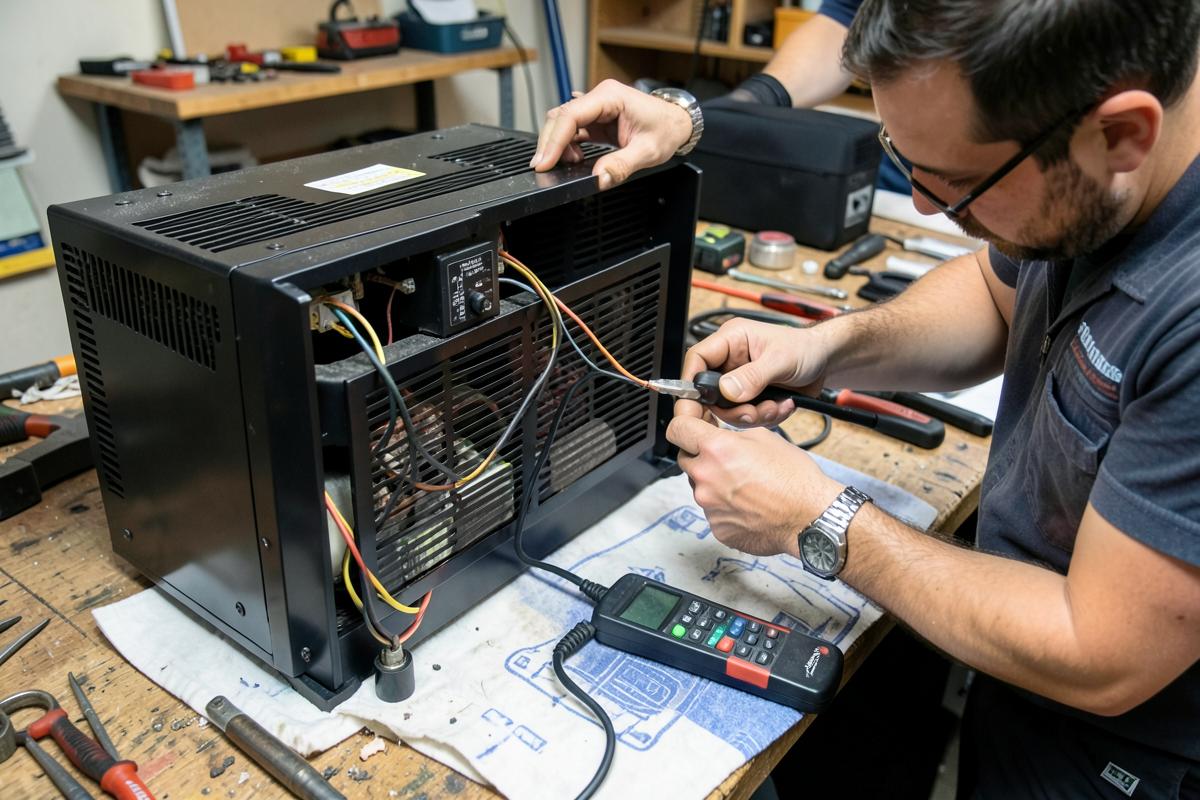
The usual failures are a heater element or its thermal cutout, the flame effect motor, an LED module, the remote receiver or the control board. Each is testable, and most are replaceable if the manufacturer still supports the model.
We test to isolate the faulty component, source the correct part where it remains available, and tell you plainly when a discontinued board makes replacement the more sensible spend.
What the visit includes
- Power supply, switch and thermal cutout testing
- Heater element and fan diagnosis
- Flame motor and LED module replacement
- Remote receiver and control board service
- Honest repair-versus-replace recommendation
Signs you need this
- The flame effect runs but no heat comes out
- The unit trips a breaker or shuts off intermittently
- Flickering, dim or dead flame effect
- The remote no longer controls the unit
Areas we cover around Strathroy
Mount Brydges · Melbourne · Glencoe · Watford · Parkhill
An electric fireplace failing rarely means the whole unit is finished, which surprises people who assume anything electronic is a throwaway once it stops working properly. In practice, most faults trace back to one identifiable component: a heater element or its thermal cutout, the motor driving the flame effect, an LED lighting module, the remote receiver, or the control board tying it all together, and each of those is testable on its own.
The diagnostic process matters more here than in almost any other hearth repair, because several very different faults produce nearly identical symptoms from across the room. A unit with flame but no heat could be a tripped thermal cutout, a failed heater element, a blown fuse, or a control board issue, and guessing at which one it is before testing usually means paying for parts that were never the problem.
Parts availability is the other variable that shapes every electric fireplace repair conversation. Manufacturers vary widely in how long they support older models, and a five-year-old unit from a well-supported brand can often be repaired cheaply and quickly, while a similarly aged unit from a brand that has since discontinued the line may leave replacement as the more sensible option even for a straightforward fault.
The most common failure points and what they look like
A heater element that has failed, or a thermal cutout that has tripped due to restricted airflow, produces the classic complaint of a flame effect running normally while no heat comes out, since the flame and heat systems in most units operate independently of one another. This is one of the more straightforward diagnoses because it can usually be isolated with a multimeter in a matter of minutes.
The flame effect motor, which drives the rotating reflective element or moving component that creates the flickering illusion, wears mechanically over years of use, showing up as a slowing, jerky or completely stalled flame effect while heat continues working fine. LED modules fail differently again, typically showing flickering, dimming or dead sections of the light strip rather than an all-or-nothing failure.
Control boards and remote receivers are the least predictable failure point because their symptoms can mimic almost anything else: a unit that will not respond to any control, that turns on and off intermittently on its own, or that only partially responds to the remote often points back to the board rather than to the heater or flame components directly.
- Flame runs, no heat: heater element or thermal cutout
- Slow or jerky flame effect: flame motor wear
- Flickering or dead LED sections: LED module failure
- No response to any control: control board or power supply
- Works only with remote very close to unit: weak receiver
How the diagnostic process actually works
Diagnosis starts with isolating whether the fault is electrical supply, a specific component, or the control system. Power supply, the wall switch if fitted, and any inline fuse are checked first because a failure here can look exactly like a component failure but costs nothing to fix once identified. Voltage testing at the heater terminals then confirms whether the element itself is receiving power and drawing correctly.
If the heater element and thermal cutout test fine, attention moves to the flame effect motor and LED assembly, both of which can usually be bench tested once removed, letting a genuine mechanical or electrical failure be distinguished from a simple loose connector that has worked its way free from normal handling and dusting over the years.
Control board diagnosis is typically last, partly because boards are the most expensive single component to replace and partly because ruling out simpler causes first avoids recommending a costly repair when the actual fault was a five-dollar fuse or a disconnected wire.
Ontario usage patterns and why faults cluster seasonally
Electric fireplaces in Ontario homes tend to see two very different use patterns: heavy near-daily use through the coldest months, then months of near-total dormancy through spring and summer. That dormancy period is often when dust accumulates around heater vents and connectors work slightly loose from seasonal temperature swings in the room, both of which show up as faults the moment the unit is switched back on for the season.
This pattern is why a unit that worked fine at the end of the previous winter can develop a fault seemingly out of nowhere in November: nothing failed suddenly, it simply sat unused long enough for a marginal connection or a dust-restricted vent to finally cause a problem once demand returned.
Electrical safety context for repair work
Electric fireplace repair work involves mains voltage components and, on larger units, currents close to a standard circuit's rated capacity, which is why any repair touching internal wiring, the heater circuit or a hard-wired connection should follow standard electrical safety practice: power disconnected at the source before any panel is opened, and components tested rather than assumed. This is not a code requirement specific to fireplaces so much as basic electrical work practice that applies to any mains-powered appliance repair.
Where a unit was originally hard-wired into a dedicated circuit rather than plugged into an outlet, any repair involving the electrical connection itself, rather than the appliance's internal components, should be handled by or coordinated with a licensed electrician, since that connection falls under the Ontario Electrical Safety Code rather than general appliance repair.
What test results actually tell you about the appliance
A thermal cutout that has tripped and resets fine once airflow around the unit is cleared is not really a fault at all, it is the safety system doing exactly what it is designed to do, and it usually means something is blocking the vents rather than the appliance itself failing. A heater element that fails to draw current at all, by contrast, is a genuine component failure and needs replacement.
Intermittent faults, ones that come and go rather than presenting consistently, are often the hardest to pin down and the most likely to point to a loose connector or a marginal solder joint on the control board rather than a fully failed component. These sometimes take more than one visit to fully resolve if the fault does not present itself during testing.
Repair versus replacement, decided honestly
Most single-component failures, a heater element, a thermal cutout, an LED strip, a remote receiver, are worth repairing on units of almost any age, since the parts themselves are inexpensive relative to the cost of a full replacement unit and installation. The calculation changes meaningfully when the control board is the failed component on an older or discontinued model, since boards are typically the single most expensive part and are the first to become unavailable once a manufacturer stops supporting a product line.
In practice, before recommending any repair on a unit more than roughly eight to ten years old, checking part availability directly with the manufacturer or a parts supplier is worth doing first, since paying for diagnostic labour only to learn the needed board is discontinued serves nobody. Being told plainly that replacement makes more sense than chasing an unavailable part is, in the long run, more useful than an optimistic repair estimate that cannot actually be fulfilled.
Warranty, resale and insurance notes
Many electric fireplace manufacturers offer multi-year warranties on major components like heater elements and control boards, and checking warranty status before paying for a repair is worth doing since some faults within the coverage window are a manufacturer's responsibility rather than an out-of-pocket repair. Keeping the original purchase receipt and model number on hand makes this check quick rather than a scavenger hunt.
For resale purposes, an electric fireplace in working order is a minor positive feature but rarely a focal point of a home inspection, since there is no combustion or venting system to assess. Where it does matter is in disclosure: a unit known to have an intermittent fault should be mentioned honestly rather than left for a buyer to discover, since the fix is usually inexpensive and straightforward once identified properly.
Electric Fireplace Repair cost in Strathroy
Most electric fireplace repairs in Ontario average between $180 and $260 once diagnosis and a single component replacement are included.
| Work | Typical range | What moves the price |
|---|---|---|
| Diagnostic visitoften credited toward the repair if completed same visit | $100 – $160 | often credited toward the repair if completed same visit |
| Heater element or thermal cutout replacementpart availability and unit brand | $150 – $320 | part availability and unit brand |
| Flame effect motor replacementmotor type and access difficulty | $120 – $260 | motor type and access difficulty |
| LED module replacementstrip length and colour-changing features | $90 – $220 | strip length and colour-changing features |
| Remote receiver replacementwhether remote or receiver alone needs replacing | $80 – $180 | whether remote or receiver alone needs replacing |
| Control board replacementboard availability, often the deciding factor on repair vs replace | $220 – $480 | board availability, often the deciding factor on repair vs replace |
Ranges are estimates for planning only, not quotes. Final pricing depends on what we find on site, access, and the condition of the existing system.
What moves the price
- Which component has actually failed
- Age of the unit and manufacturer parts availability
- Whether the unit is plugged in or hard-wired
- Access difficulty if built into a media wall or tight recess
- Whether the fault is intermittent and needs repeat diagnosis
- Remaining manufacturer warranty coverage, if any
Want a number for your own fireplace? Send us the details and we will come back with an estimate, or call (833) 949-4153.
How the work goes, step by step
- 1
Symptom review and initial testing
The reported symptoms are reviewed and basic checks are made first, including power supply, any wall switch, and inline fuses, since these can mimic a component failure but cost nothing to resolve.
- 2
Component isolation
Voltage and continuity testing at the heater, flame motor and LED assembly narrow the fault down to a specific component rather than relying on guesswork based on symptoms alone.
- 3
Parts availability check
For units where a faulty component may need replacing, part availability is confirmed with the manufacturer or supplier before committing to a repair path, particularly for older or discontinued models.
- 4
Component replacement
The identified faulty part, whether a heater element, motor, LED module or receiver, is removed and replaced, with surrounding wiring and connectors checked for wear at the same time.
- 5
Reassembly and full function test
The unit is reassembled and run through heat, flame effect, remote and any additional feature such as colour-changing LEDs to confirm the fault is fully resolved rather than only partially improved.
- 6
Recommendation on remaining service life
Where other components show early wear during testing, that is flagged honestly so a decision on further repair or eventual replacement can be planned rather than arriving as a surprise.
How long it takes: Most single-component repairs are completed in one visit lasting 45 minutes to two hours depending on unit access and part availability.
Looking after it afterwards
- Keep heater vents free of dust buildup to reduce strain on the element
- Avoid leaving the unit running unattended for extended periods
- Replace remote batteries at the first sign of delayed response
- Note any recurring symptom pattern to help speed up future diagnosis
- Register the unit with the manufacturer to simplify future warranty checks
Mistakes we see most often
- Assuming a unit with flame but no heat is a full failure rather than one component
- Continuing to run a unit that trips its thermal cutout repeatedly without checking airflow
- Replacing the remote before testing the receiver inside the unit
- Paying for a control board repair on a model with no parts support left
- Ignoring an intermittent fault until it becomes a full failure
Questions homeowners ask
- Why does the heater cut out after a while?
- Usually the thermal cutout doing its job because airflow is restricted, or a failing element drawing incorrectly. Both are testable in one visit.
- Are parts available for older units?
- It varies by brand. We check part availability before recommending a repair so you are not paying for a diagnosis that leads nowhere.
- Why does my electric fireplace trip a breaker?
- This is most often the heater element drawing more current than it should due to an internal fault, or the unit sharing an overloaded circuit with other appliances. Testing the element's current draw usually identifies which of the two is happening.
- My flame effect looks dim, is that a big repair?
- Usually not. Dimming or flickering flame effect lighting is typically an LED module or connector issue, both inexpensive and quick to replace once the unit is opened up for inspection.
- Is it worth repairing a ten-year-old unit?
- It depends entirely on which component failed and whether parts are still available. Simple parts like elements and remotes are often still supported even on older units, while control boards on discontinued models sometimes are not.
- Can I test the heater element myself?
- Basic checks like confirming the unit is receiving power and that vents are not blocked are reasonable to check yourself, but testing the element itself involves opening the unit and working with mains voltage, which is better left to a technician.
- Why does the remote only work up close to the unit?
- This usually points to a weakening receiver inside the unit rather than the remote itself, and replacing the receiver typically restores normal range without needing a new remote.
- Does the manufacturer's warranty cover repairs?
- It can, particularly on major components like heater elements and control boards within the stated warranty period, so checking the original purchase date and model number before paying for a repair is worth doing first.
Nearby
Other Communities Near Strathroy
Related work
Often Booked Together
Electric Installation in Strathroy
Wall-mount, built-in and media-wall electric fireplace installation with clean wiring.
Chimney Sweeping in Strathroy
Full mechanical sweep of the flue, smoke chamber and firebox with containment and photos.
Chimney Inspection in Strathroy
Documented inspection of the flue, liner and structure with photos and a plain-language report.
Chimney Repair in Strathroy
Targeted repairs to crowns, caps, mortar joints, flashing and liners.