
Ontario Fireplace & Chimney Specialists
Dryer Vent Cleaning in Port Colborne
Lint in a dryer duct is a fire load and a hydro bill at the same time.
Every job starts with a proper look at your system — not a guess over the phone. You get a written quote before any work begins, a clear explanation of what we found, and a technician who works to manufacturer and code requirements from start to finish.
- Written quotes, no surprise charges
- Photo-backed findings after every visit
- Work performed to code and manufacturer specs
- Serving Port Colborne and Niagara Region, year-round
Dryer Vent Cleaning for Port Colborne homes
Port Colborne's pre-war and post-war housing largely uses masonry chimneys, many built when the appliance below was a coal or oil unit and later adapted for gas.
Oversized flues left behind by those conversions cause condensation and liner deterioration, which is why sizing checks are part of every gas inspection we do here.
Lint escapes every filter and settles along the duct, especially at elbows and any crushed section. As the duct restricts, drying times climb, the appliance runs hotter and the lint sits closer to a heat source than anyone would choose.
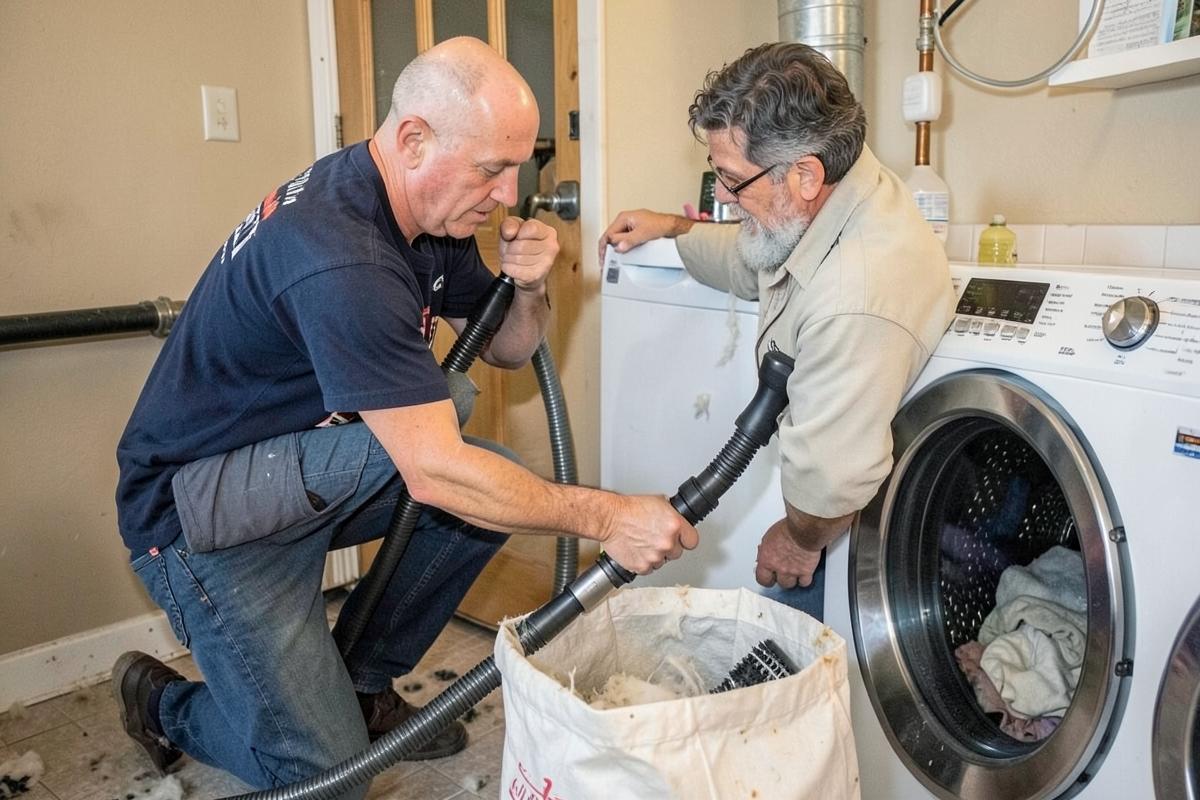
We clean the full duct length with rotary brushing and vacuum extraction from both ends, inspect and clear the exterior termination flap, and measure airflow before and after so the improvement is a number rather than an impression.
What the visit includes
- Full-length rotary brushing and vacuum extraction
- Transition hose inspection and crush check
- Exterior termination and flap cleaning
- Before and after airflow measurement
- Duct routing and material recommendations
Signs you need this
- Clothes take two cycles to dry
- The dryer or laundry room feels unusually hot
- A burning or musty smell during a cycle
- Lint visible around the outside vent hood
Areas we cover around Port Colborne
Sherkston · Wainfleet · Humberstone · Bethel · Perry
A clothes dryer vent carries hot, moist air loaded with fine lint out of the house, and over time that lint accumulates along the interior of the duct, at bends and transitions, and around the exterior hood flap, gradually restricting airflow even when the dryer itself seems to be running normally. A restricted vent forces the dryer to work harder, run longer per load, and run hotter internally, and in more serious cases, an accumulated lint blockage is a documented and recurring cause of house fires.
Many Ontario homeowners associate dryer vent cleaning with chimney sweeping companies simply because both involve clearing a duct of combustible buildup with similar rotary brush tools, and the comparison is apt: lint behaves in some ways like a mild version of creosote, building up gradually in a hidden passage until it becomes a real hazard, and it responds to the same kind of mechanical brushing and vacuum containment approach a chimney flue does.
This page covers how vent length, routing and termination type affect cleaning frequency, what a proper cleaning actually involves, and the warning signs that indicate a vent needs attention sooner than its regular schedule would suggest.
How lint accumulates and why it matters
Every load of laundry releases lint that the dryer's internal lint trap is designed to catch, but that trap is never one hundred percent effective, and the portion that escapes travels down the exhaust duct where it settles more readily at bends, seams, and anywhere airflow slows or turbulates. Longer duct runs and runs with multiple bends accumulate lint faster relative to their length than a short, straight run to an exterior wall does, simply because there are more places for lint to catch.
As lint builds, it restricts airflow, and a dryer fighting restricted airflow takes longer to dry each load, runs at a higher internal temperature to compensate, and puts more wear on its heating element and blower motor than a dryer venting freely. Homeowners often notice the longer drying times well before they think to connect that symptom to the vent itself rather than the dryer.
The fire risk comes from lint's combustibility combined with the heat already present inside a running dryer's exhaust path; a substantial lint accumulation sitting against a duct wall near the dryer's heating element is fuel sitting next to an ignition source, and national fire data consistently identifies dryer vent lint as a leading cause of home dryer fires.
How duct length and routing affect cleaning frequency
A short, straight duct run from the dryer to a nearby exterior wall, common in bungalows and homes where the laundry room sits against an outside wall, accumulates lint more slowly and evenly than a long run snaking through multiple floor joists or up through a wall cavity to a roof termination. Longer and more convoluted runs are common in homes where laundry was relocated to a basement or interior room during a renovation, and those runs generally need cleaning more frequently than the general annual guideline suggests.
Roof-terminated vents, sometimes necessary in homes without a convenient exterior wall route, tend to accumulate lint at the transition points where the duct turns from horizontal to vertical, and the vertical run itself can trap lint against gravity in ways a horizontal run to a nearby wall does not, making roof terminations a common candidate for more frequent inspection.
Rigid metal duct, the material generally recommended for dryer venting, moves air and resists lint accumulation better than flexible foil or plastic ducting, which has more interior ridges for lint to catch on and, in the case of plastic ducting particularly, poses a greater fire risk and has fallen out of favour in current installation practice.
- Short, straight runs to a nearby exterior wall accumulate lint most slowly
- Long runs with multiple bends need more frequent cleaning
- Roof-terminated vents trap lint at horizontal-to-vertical transitions
- Rigid metal duct resists lint buildup better than flexible foil or plastic
What a professional cleaning visit involves
A technician typically disconnects the dryer from the duct at the machine end, or accesses the duct from the exterior termination point, depending on which approach gives better access for the specific layout, and feeds a rotary brush or air-whip cleaning tool through the full length of the duct while a vacuum captures the dislodged lint rather than letting it scatter into the room or yard.
The exterior hood and its flap or louvers are cleaned and checked for free movement, since a flap that has become stuck open invites pests and drafts, while one stuck closed blocks the vent entirely regardless of how clean the duct itself is. Any screening at the exterior hood, which is generally discouraged since it catches lint and defeats the vent's purpose, is noted if present and typically recommended for removal.
Once the duct is clear, the dryer is reconnected and, where practical, run through a brief cycle to confirm the exterior flap opens properly and exhaust airflow feels strong at the termination point, giving a functional confirmation alongside the visual clearing of the duct itself.
Warning signs a vent needs attention
Clothes taking noticeably longer to dry than they used to, a dryer that feels hotter to the touch on its exterior cabinet during operation, a burning smell during a drying cycle, or visible lint accumulating around the exterior hood flap are all signs that warrant a cleaning sooner than the next scheduled annual visit. A musty smell in clothes after drying can also indicate moisture trapped in a restricted duct rather than venting properly outside.
Checking the exterior termination point periodically is a simple homeowner task: if the flap does not lift and flutter noticeably when the dryer is running, or if lint is visibly built up around its edges, that is a reasonably reliable indicator that the duct behind it needs clearing.
Special cases: long runs, multiple units and commercial-style setups
Homes with laundry rooms relocated well away from an exterior wall, common in basement renovations, sometimes have duct runs long enough that a standard single-pass brush cleaning is not fully effective, requiring a booster fan installed partway along the run to maintain adequate airflow velocity, or in some cases a full reroute to shorten the path if the existing run consistently underperforms even with regular cleaning.
Multi-unit residential buildings and homes with side-by-side laundry pairs sharing wall space sometimes have duct runs that were installed with shortcuts, shared termination points or excessive length, that fall outside what a single-family home's typical vent looks like, and those setups generally benefit from a one-time thorough assessment to identify whether the routing itself, not just the accumulated lint, is limiting performance.
Choosing a cleaning frequency for a typical household
Once a year is the commonly cited baseline for a typical single-family household with a moderate laundry volume and a reasonably short, straight duct run, timed whenever is convenient rather than tied to a particular season the way chimney sweeping is. Households doing significantly more laundry than average, larger families, home-based businesses with heavy linen use, should consider cleaning every six to nine months instead.
Longer or more convoluted duct runs, as discussed above, warrant more frequent attention regardless of laundry volume, and any household noticing the warning signs described earlier should treat that as reason to book a cleaning immediately rather than waiting for their next scheduled interval.
Interaction with dryer maintenance more broadly
Vent cleaning addresses the exhaust path but does not replace cleaning the dryer's internal lint trap after every load, which remains the single most effective daily habit for keeping lint out of the duct in the first place. It also does not address lint that can accumulate inside the dryer cabinet itself, around the drum and heating element, which is a separate internal cleaning task some dryer repair technicians perform as part of broader appliance maintenance.
A dryer that continues to show poor performance even after a professional vent cleaning may have an internal issue, a failing heating element, a worn belt, or an internal lint accumulation around the blower housing, that sits beyond the scope of exterior vent cleaning and would need a dryer repair technician rather than a vent cleaning service to resolve.
Dryer Vent Cleaning cost in Port Colborne
A standard annual dryer vent cleaning for a typical single-family home runs between $120 and $200 depending on run length and access.
| Work | Typical range | What moves the price |
|---|---|---|
| Standard single dryer vent cleaning, short straight runtypical single-storey home with an exterior wall termination | $120 – $180 | typical single-storey home with an exterior wall termination |
| Long or multi-bend duct run cleaningreflects extra time and tooling for longer or more complex routing | $180 – $280 | reflects extra time and tooling for longer or more complex routing |
| Roof-terminated dryer vent cleaningincludes roof access and vertical run clearing | $200 – $320 | includes roof access and vertical run clearing |
| Heavy lint blockage removalfor vents with significant restriction found on inspection | $220 – $380 | for vents with significant restriction found on inspection |
| Booster fan installation for long runsadded to maintain airflow on ducts exceeding standard length guidelines | $250 – $500 | added to maintain airflow on ducts exceeding standard length guidelines |
| Duct rerouting or shorteningfor chronically underperforming runs where cleaning alone does not resolve the issue | $400 – $1,200 | for chronically underperforming runs where cleaning alone does not resolve the issue |
Ranges are estimates for planning only, not quotes. Final pricing depends on what we find on site, access, and the condition of the existing system.
What moves the price
- Total duct length and number of bends in the run
- Whether the vent terminates through a wall or through the roof
- Amount of lint restriction found at the time of cleaning
- Whether a booster fan or rerouting is needed for a chronically long run
- Access difficulty, including exterior height for roof terminations
- Number of dryer vents serviced at a multi-unit property
Want a number for your own fireplace? Send us the details and we will come back with an estimate, or call (833) 949-4153.
How the work goes, step by step
- 1
Inspect the current setup
The duct routing, material and termination type are assessed to determine the best cleaning approach and identify any restriction hotspots.
- 2
Disconnect and access the duct
The dryer is disconnected from the duct, or the exterior termination is accessed, depending on which gives better cleaning access.
- 3
Brush and vacuum the full run
A rotary brush or air-whip tool clears lint along the full duct length while a vacuum captures dislodged material.
- 4
Clean the exterior hood and flap
The termination hood is cleared of lint buildup and checked to confirm the flap opens and closes freely.
- 5
Reconnect and test airflow
The dryer is reconnected and run briefly to confirm strong exhaust airflow and proper flap movement at the termination.
- 6
Note any structural concerns
Any duct damage, incorrect material, or routing issues found during the cleaning are documented for the homeowner.
How long it takes: A standard single dryer vent cleaning typically takes thirty to sixty minutes; longer or roof-terminated runs can take up to ninety minutes.
Looking after it afterwards
- Clean the dryer's internal lint trap after every load without exception
- Check the exterior vent flap periodically to confirm it moves freely when the dryer runs
- Watch drying times as an early indicator that the duct may be restricting again
- Avoid using flexible foil or plastic replacement ducting if any section needs repair
- Book the next cleaning on an annual basis, or sooner for heavy laundry households
Mistakes we see most often
- Relying solely on the internal lint trap and assuming the duct never needs attention
- Using plastic or foil flexible ducting for a full exhaust run instead of rigid metal
- Ignoring longer drying times as simply a sign the dryer is aging
- Adding a screen over the exterior vent hood, which traps lint and restricts airflow
- Delaying cleaning on a long or roof-terminated run past the standard annual interval
Questions homeowners ask
- How often should a dryer vent be cleaned?
- Annually for a typical household, and more often with a large family, a long duct run or a vent that terminates on the roof.
- Is flexible foil duct acceptable?
- It traps lint and crushes easily. Rigid or semi-rigid metal duct is the better choice, and we will say so if we find foil behind the appliance.
- How often should a dryer vent be cleaned?
- Once a year is a reasonable baseline for a typical household with a short, straight duct run and moderate laundry volume, while longer or more convoluted runs, roof terminations, and heavier laundry volume households should generally plan for cleaning every six to nine months instead.
- What are the signs a dryer vent needs cleaning sooner than scheduled?
- Noticeably longer drying times, a dryer that feels hotter than usual on its exterior cabinet, a burning smell during operation, and visible lint buildup around the exterior hood flap are all reasonable signs to book a cleaning before the next regular interval arrives.
- Is flexible foil ducting safe to use for a dryer vent?
- Rigid metal duct is generally preferred because it resists lint accumulation and handles heat better than flexible foil or plastic ducting, which have more interior ridges for lint to catch and, particularly in the case of plastic, carry a greater fire risk over a long exhaust run.
- Can a long duct run always be fixed with a booster fan?
- A booster fan helps maintain adequate airflow velocity on runs that exceed standard length guidelines, but it is not a universal fix, and some chronically underperforming runs are better addressed by shortening or rerouting the duct rather than adding a fan to compensate for an inherently difficult layout.
- Does cleaning the lint trap after every load eliminate the need for duct cleaning?
- No, since even a diligently cleaned lint trap does not catch all lint, and the portion that escapes still accumulates gradually inside the duct itself, which is why professional duct cleaning remains necessary on its own schedule regardless of how consistently the trap is cleaned.
- Why do roof-terminated dryer vents need more frequent cleaning?
- Roof-terminated vents accumulate lint at the transition point where the duct turns from horizontal to vertical, and the vertical run itself can trap lint against gravity in a way a short horizontal run to a nearby exterior wall generally does not, which is why they are often checked more frequently than wall-terminated vents.
Nearby
Other Communities Near Port Colborne
Related work
Often Booked Together
Dryer Vent Repair in Port Colborne
Rerouting, resealing and replacing crushed, disconnected or improperly vented ducting.
Air Duct Cleaning in Port Colborne
Supply and return duct cleaning with negative-air containment and before-and-after photos.
Chimney Fan in Port Colborne
Mechanical draft fans for chimneys that cannot draft adequately on their own.
Chimney Sweeping in Port Colborne
Full mechanical sweep of the flue, smoke chamber and firebox with containment and photos.