
Ontario Fireplace & Chimney Specialists
Chimney Sweeping in Sudbury
A clean flue burns better, drafts better and is far less likely to catch fire.
Every job starts with a proper look at your system — not a guess over the phone. You get a written quote before any work begins, a clear explanation of what we found, and a technician who works to manufacturer and code requirements from start to finish.
- Written quotes, no surprise charges
- Photo-backed findings after every visit
- Work performed to code and manufacturer specs
- Serving Sudbury and Greater Sudbury Area, year-round
Chimney Sweeping for Sudbury homes
Sudbury housing ranges from older brick and block in the central neighbourhoods to newer construction around New Sudbury and Val Caron, and wood or pellet appliances are common as either primary or backup heat.
With appliances running hard for months at a stretch, creosote accumulates fast and gaskets and baffles wear faster than in the south. Mid-season sweeps are worth considering here rather than a single annual visit.
A sweep removes the soot and creosote layers that build on flue walls every burning season. We brush the full length of the flue, clear the smoke shelf and smoke chamber, and vacuum the firebox with sealed containment so nothing settles on your floors or furniture.
Sweeping is also the point where problems get found. With the flue clean, the liner joints, damper, crown and cap are visible for the first time since the last visit, so you get a written note of anything worth watching before it turns into a repair.
What the visit includes
- Drop cloths and a sealed HEPA vacuum around the hearth
- Rotary or rod-and-brush sweep of the full flue length
- Smoke shelf, smoke chamber and firebox cleanout
- Damper operation check and lubrication
- Photo record and written condition summary
Signs you need this
- You have not had the chimney swept in over a year of use
- Black flakes or grit falling into the firebox
- Smoke pushing into the room when you light a fire
- A sharp, tarry smell on humid days
Areas we cover around Sudbury
New Sudbury · Val Caron · Lively · Garson · Copper Cliff
Every time a wood fire burns, it leaves behind a residue that does not simply vanish with the smoke. Fine soot, unburned wood tar and creosote condense on the inner walls of the flue, layer over layer, season after season. Left alone, that buildup narrows the passage, chokes off draft and, in the worst cases, ignites inside a flue that was never designed to burn on the inside as well as the outside. Sweeping is the single most effective thing a homeowner can do to keep a wood-burning system safe and working the way it should.
Ontario burners face a particular set of pressures that make sweeping more than a once-in-a-while chore. Long heating seasons mean more total burn hours than milder climates see, and the temptation to load a stove or fireplace overnight with a slow, smouldering fire produces exactly the cool, incomplete combustion that deposits the stickiest, most flammable creosote. Add in a mix of seasoned and not-quite-seasoned firewood, and a flue that looked fine in October can be dangerously coated by February.
This page walks through what a proper sweep actually involves, what the findings during a sweep tend to mean, how often the work should happen in a typical Ontario household, and what it costs. It is written for people who burn wood regularly, people who use their fireplace only a handful of nights a year, and people who have just bought a house with a fireplace they know nothing about yet.
What happens during a mechanical sweep
A sweep starts with containment, not brushing. The hearth and surrounding floor are covered, and the fireplace opening is sealed against a HEPA-filtered vacuum so that negative pressure holds any dislodged soot inside the system rather than letting it drift into the room. Only once that containment is in place does the actual brushing begin.
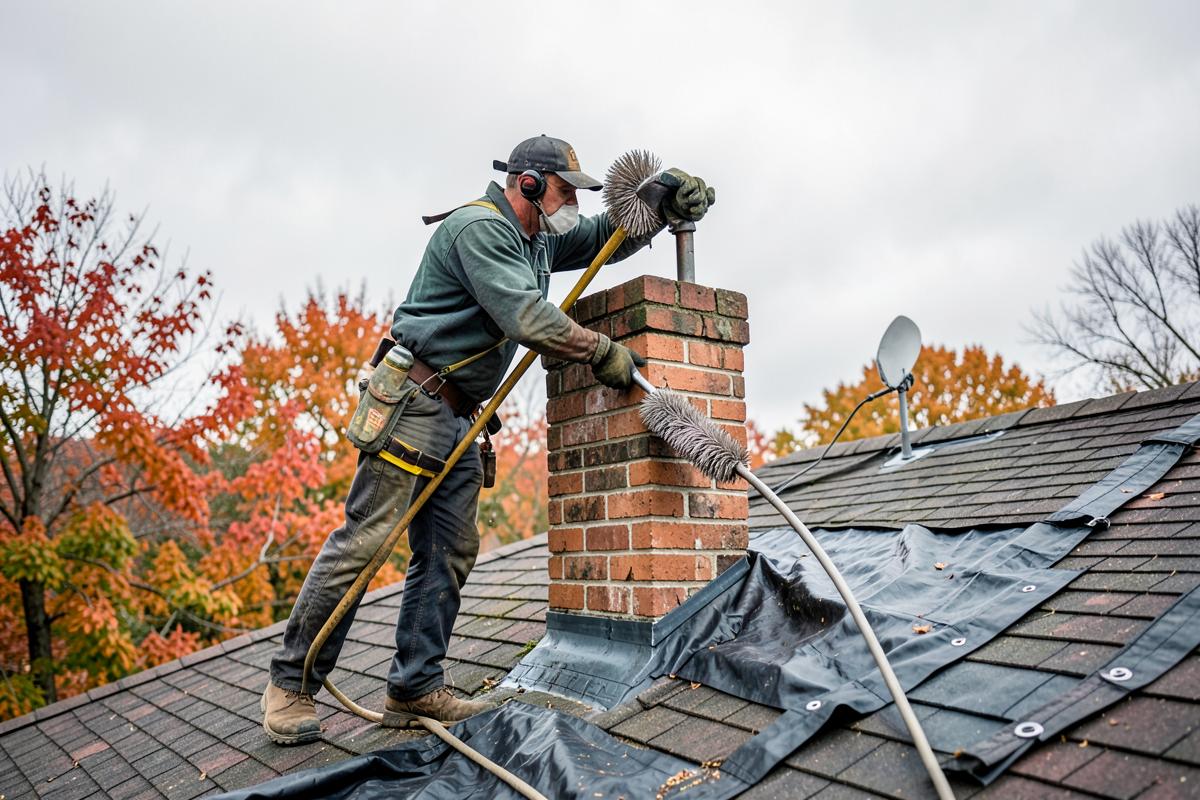
The technician works a rotary or rod-and-brush head sized to the flue's shape and dimension along its full length, from the damper or appliance connector up past the smoke chamber and out the top. Rotary systems use a flexible whip spinning a brush head, which tends to clear glazed creosote more effectively than a stiff rod system; rod-and-brush setups remain common and perfectly adequate for lighter, flaky soot. Either way, the goal is the same: strip the flue walls back to bare liner material.
Once the flue is clear, attention moves to the smoke shelf and smoke chamber, an irregular cavity above the damper that collects a surprising amount of debris and is easy to forget about because it is invisible from both the firebox and the roof. The firebox itself is vacuumed last, and the ash is checked for embers before anything is bagged for disposal.
Why creosote forms and why it matters
Creosote is a byproduct of incomplete combustion. Hot, well-aerated fires burning dry, seasoned wood produce mostly carbon dioxide and water vapour; cooler, oxygen-starved fires burning damp or unseasoned wood produce a much higher proportion of unburned hydrocarbons that condense on the first cool surface they touch, which is usually the flue wall a few feet above the fire. Over a season this can build from a light dusty layer into a hard, glazed coating that is difficult to remove and highly combustible.
There are recognised stages, from a light flaky soot that brushes off easily, through a more textured tar-like layer, to a hardened glaze that can look almost like black glass. That third stage is the one that concerns sweeps most, because it does not respond fully to a standard brush and can require chemical treatment or mechanical scraping in addition to brushing, and because it is the stage most likely to sustain a self-fed chimney fire once ignited.
A chimney fire in a well-lined masonry flue is loud, frightening and sometimes survivable without damage; in a flue with any pre-existing crack or gap it can push flame directly into wall framing. Regular sweeping keeps the fuel load for that scenario as close to zero as reasonably possible, which is the entire point of the exercise.
- Stage 1 soot: light, sooty, brushes off completely
- Stage 2 creosote: darker, textured, tar-like in patches
- Stage 3 glaze: hardened, shiny, resists standard brushing
- Glaze most often results from smouldering, oxygen-starved fires
- Chimney fires can reach flue temperatures over 1,000°C
How Ontario's climate and burning habits affect the schedule
A five-month or longer heating season means an average Ontario wood burner can log fifty to a hundred or more fires per year, considerably more than a household in a milder climate that lights a fire occasionally for atmosphere. That volume alone pushes annual sweeping from a nice-to-have into a practical necessity for anyone who burns regularly through the winter.
Firewood moisture content is the other big regional variable. Properly seasoned hardwood should sit under twenty percent moisture, which typically means splitting and stacking it under cover for at least six to twelve months before burning. Wood sold as 'seasoned' at a roadside stand in October has often had nowhere near that time, and burning it produces noticeably more creosote than the same species properly dried. A moisture meter is a worthwhile ten-dollar investment for anyone burning wood in this climate.
Overnight loading, a common habit through a Canadian winter to keep some heat going until morning, is one of the single biggest creosote contributors because it deliberately restricts air to slow the burn. Households that load overnight regularly should treat a mid-season inspection, not just an annual sweep, as part of the routine.
What a sweep can reveal about the rest of the system
Once soot is cleared away, surfaces that were previously hidden become visible for the first time since the last cleaning. Liner joints, cracked tiles, a damper that has rusted stuck, or a crown with a visible crack often only get spotted at this point, which is why most reputable sweeps end with a short written note on anything worth watching, separate from the cleaning itself.
This is also when a sweep can catch signs of previous chimney fires that were never reported, such as flaking or bubbled liner tile, warped damper plates, or discoloured mortar joints in the smoke chamber. Those findings do not necessarily mean an emergency, but they do mean a closer inspection is worth booking before the next heating season.
Gas appliances need service, not sweeping
It is worth separating wood sweeping from gas appliance service, because they are frequently confused. A gas fireplace or insert does not produce creosote in any meaningful quantity, so a rotary brush has nothing to do there. What a gas unit needs annually is a service visit: burner and pilot cleaning, glass and gasket inspection, venting checks, and a combustion check where equipment allows.
Homeowners who convert from wood to gas sometimes keep booking an annual 'chimney sweep' out of habit when what they actually need is a gas service call, and the reverse mistake happens too, with wood burners occasionally skipping cleaning because they assume a general 'chimney check' covers it. Being specific about fuel type when booking avoids paying for the wrong kind of visit.
Insurance and resale considerations
Many Ontario home insurers now ask, at renewal or at new policy underwriting, whether a wood-burning appliance has been serviced within the past year, and some decline or complicate claims related to chimney fires where no sweeping record exists. Keeping the invoice and any written report from each visit is a simple habit that can matter a great deal if a claim is ever filed.
At resale, a buyer's home inspector will almost always flag an unswept or unknown-condition chimney as a line item, and a seller who can produce a recent sweeping record and inspection report typically avoids that becoming a negotiating point. It is a small, inexpensive piece of paperwork that carries outsized weight during a real estate transaction.
Choosing how often to book
The commonly cited baseline is once per heating season for a fireplace or stove in regular use, but 'regular use' covers a wide range of actual burning habits. A household burning most winter evenings, burning softwood, or loading overnight fires should plan on a mid-season check as well, particularly if a lot of wood has gone through the appliance by January.
Households that burn only occasionally, for a handful of evenings around the holidays, can often stretch to sweeping every one to two years, but that decision should follow an inspection finding rather than a guess, since infrequent use with poor wood quality can still build creosote faster than expected.
- Regular winter burners: sweep every heating season
- Overnight or slow-burn habits: add a mid-season check
- Occasional burners: sweep at least every one to two years
- New to the house: always sweep and inspect before first use
- After any chimney fire: sweep and inspect before relighting
Chimney Sweeping cost in Sudbury
Most Ontario households pay in the neighbourhood of $220 to $280 for a standard annual sweep on an accessible single flue.
| Work | Typical range | What moves the price |
|---|---|---|
| Single-flue sweep, easy roof accessstandard single-storey masonry or factory-built chimney | $180 – $260 | standard single-storey masonry or factory-built chimney |
| Single-flue sweep, steep or multi-storey accessreflects extra time and fall-protection setup on the roof | $260 – $360 | reflects extra time and fall-protection setup on the roof |
| Heavy creosote removal (stage 2/3 buildup)chemical treatment or extended scraping beyond a standard brush pass | $320 – $520 | chemical treatment or extended scraping beyond a standard brush pass |
| Sweep plus written condition reportcombined visit noting liner, damper and crown condition | $225 – $340 | combined visit noting liner, damper and crown condition |
| Wood stove or insert sweepincludes connector pipe disassembly where required | $200 – $300 | includes connector pipe disassembly where required |
| Multi-flue property (two or more fireplaces)priced per additional flue after the first | $320 – $520 | priced per additional flue after the first |
Ranges are estimates for planning only, not quotes. Final pricing depends on what we find on site, access, and the condition of the existing system.
What moves the price
- Roof pitch, height and access difficulty
- Amount and hardness of creosote buildup found on site
- Whether a connector pipe or insert needs disassembly to reach the flue
- Number of flues serviced in one visit
- Whether a written inspection report is bundled with the sweep
- Travel distance for rural or cottage-country properties
Want a number for your own fireplace? Send us the details and we will come back with an estimate, or call (833) 949-4153.
How the work goes, step by step
- 1
Protect the space
Drop cloths go down around the hearth and onto nearby furniture, and the fireplace opening is sealed to a containment vacuum before any tool touches soot.
- 2
Assess access
The technician checks roof pitch, ladder placement and any obstructions such as satellite dishes or overhanging branches to plan the safest working position.
- 3
Brush the flue
A properly sized rotary or rod brush is worked the full length of the flue from top to bottom or bottom to top, clearing soot and creosote from the liner surface.
- 4
Clear the smoke chamber
The often-overlooked cavity above the damper is brushed and vacuumed out, since it collects debris that a straight flue brush alone will not reach.
- 5
Vacuum the firebox
Loosened material is vacuumed from the firebox and ash bed, checked for embers, and bagged for removal from the property.
- 6
Document findings
Photos are taken of the cleaned flue, damper and visible liner joints, and any concerns are noted in writing for the homeowner's records.
How long it takes: A standard single-flue sweep typically takes forty-five minutes to an hour and a half, depending on access and buildup.
Looking after it afterwards
- Burn only seasoned hardwood under roughly twenty percent moisture content
- Avoid overnight smouldering loads that starve the fire of air
- Keep the damper fully open while burning to maintain strong draft
- Have ash removed and checked for embers before bagging it for disposal
- Book the next sweep before the following heating season begins, not partway through it
Mistakes we see most often
- Assuming an occasionally used fireplace does not need annual attention
- Burning green or wet firewood to save money on seasoned cordwood
- Using chemical creosote-remover logs as a substitute for mechanical sweeping
- Skipping the smoke chamber because the flue itself looks clean from the firebox
- Waiting until a smoke smell or draft problem appears before booking a sweep
Questions homeowners ask
- How often should a chimney be swept?
- Once per heating season is the usual guidance for a regularly used wood-burning fireplace, and more often if you burn most evenings or burn softwood. Gas appliances need a yearly service rather than a sweep.
- Will sweeping make a mess?
- It should not. The hearth is sheeted, the opening is sealed to a vacuum, and debris leaves in a bag rather than into the room.
- Can I sweep my own chimney?
- It is physically possible with the right brush and rod set, but most homeowners lack the roof access equipment, containment setup and experience reading creosote stage to know when brushing alone is not enough. A professional sweep also produces a written record that matters for insurance and resale, which a DIY job does not.
- Does sweeping fix a smoky fireplace?
- Sometimes, if the smoke was caused by a restricted flue from buildup. If smoking continues after a clean sweep, the cause is more likely draft, damper adjustment, flue sizing or an outdoor pressure issue, and those need a separate diagnostic visit.
- Is sweeping needed for a chimney that is never used?
- Yes, though less often. Unused flues still collect nesting debris, leaves and animal activity, and an unswept, unused chimney can also hide structural deterioration that goes unnoticed for years without any inspection.
- What is the mess like during a sweep?
- With proper containment there should be effectively none. The hearth is sheeted, the fireplace opening is sealed to a vacuum, and debris is bagged rather than left loose, so a well-run sweep leaves no visible soot in the room.
- Do pellet stoves need sweeping the same way?
- Pellet stoves produce far less creosote than cordwood but still need periodic venting and exhaust cleaning, following the appliance manufacturer's schedule, which is often more frequent than an annual wood chimney sweep because of ash and fine particulate buildup in narrower pellet venting.
- Should sweeping happen before or after winter?
- Late summer or early autumn is the most common timing, since it clears the season's buildup before the next heavy use begins and leaves time to schedule any repairs the sweep uncovers before cold weather sets in.
Nearby
Other Communities Near Sudbury
Related work
Often Booked Together
Chimney Repair in Sudbury
Targeted repairs to crowns, caps, mortar joints, flashing and liners.
Chimney Liner in Sudbury
Stainless steel and cast-in-place relining sized to the appliance being vented.
Chimney Cap in Sudbury
Stainless caps and multi-flue covers that keep out rain, snow, animals and embers.
Flashing Repair in Sudbury
Step and counter-flashing repair where the chimney meets the roof.