Ontario Fireplace & Chimney Specialists
Chimney Inspection in Listowel
Know exactly what condition your chimney is in, in writing.
Every job starts with a proper look at your system — not a guess over the phone. You get a written quote before any work begins, a clear explanation of what we found, and a technician who works to manufacturer and code requirements from start to finish.
- Written quotes, no surprise charges
- Photo-backed findings after every visit
- Work performed to code and manufacturer specs
- Serving Listowel and Perth County, year-round
Chimney Inspection for Listowel homes
Listowel's brick housing sits within farm country where pellet stoves, wood stoves and outdoor furnaces all appear regularly as primary or backup heat.
Pellet venting clogs long before anyone notices a performance problem, and most of the shutdown faults we attend here clear once the exhaust run is properly cleaned.
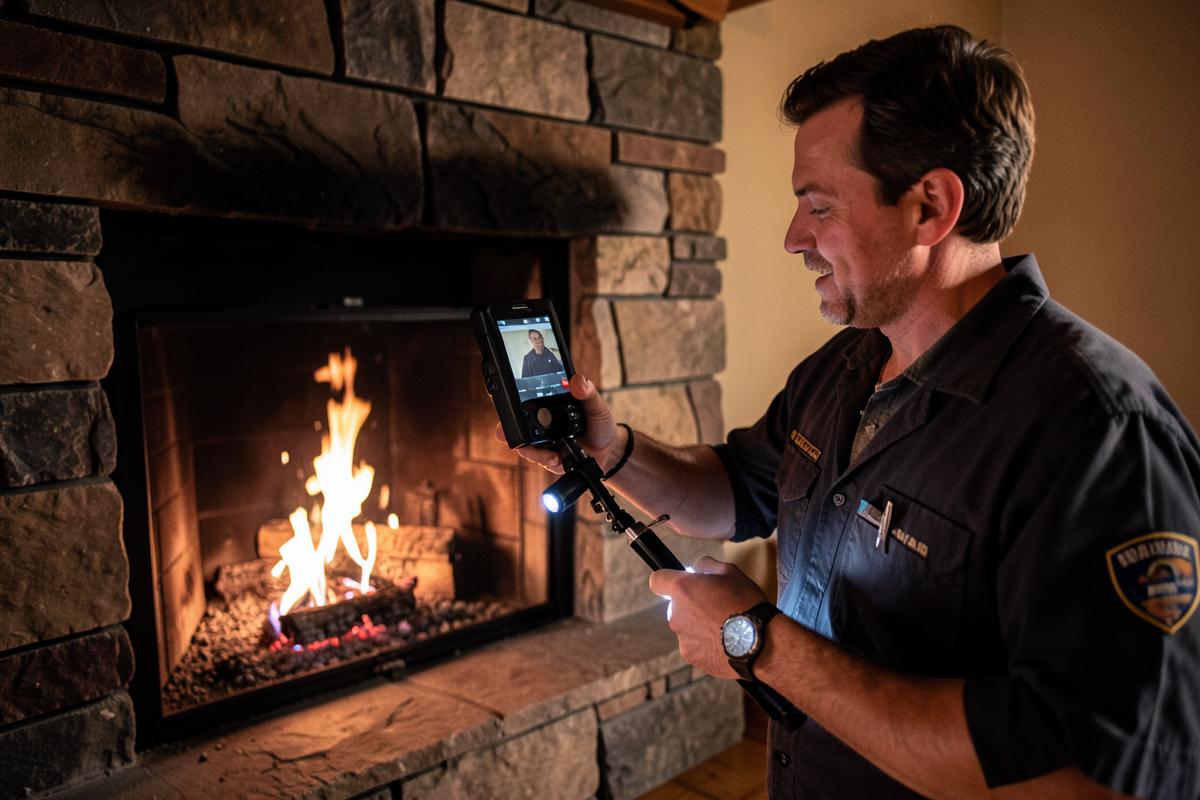
An inspection works through the system from the firebox to the termination: liner condition and joints, damper, smoke chamber, crown, cap, flashing and clearances to combustible framing. Where access allows, we use a camera to look at surfaces you cannot see from either end.
You receive photographs and a report written in ordinary language, with findings sorted by whether they are safety issues, repairs to plan for, or things to simply keep an eye on. That distinction is what makes a report useful when you are deciding what to spend.
What the visit includes
- Interior and exterior visual assessment
- Camera scan of the flue where access permits
- Liner, damper and smoke chamber evaluation
- Crown, cap and flashing check from the roof where safe
- Photo report with prioritised findings
Signs you need this
- You are buying or selling a home with a fireplace
- The chimney has never been inspected since you moved in
- There has been a chimney fire, lightning strike or roof leak
- You are changing fuel type or adding an insert
Areas we cover around Listowel
Atwood · Palmerston · Milverton · Monkton · Gowanstown
A chimney inspection answers a question that a sweep alone cannot: not just whether the flue is clean, but whether the whole system is structurally sound and safe to use as intended. It looks at everything from the firebox floor to the termination above the roofline, and it puts the findings in writing rather than leaving them as a verbal impression that fades within a week.
Ontario's building stock includes a huge range of chimney ages and construction methods, from century-old masonry stacks with soft lime mortar to factory-built metal chimneys installed a few years ago behind a gas insert. Each type fails in different ways and at different rates, and an inspection tailored to the actual construction is worth far more than a generic once-over.
This page explains what the recognised inspection levels actually involve, when each one is appropriate, what a camera scan can and cannot show, and how the resulting report gets used in practice, whether that is planning a repair budget, closing a real estate deal or satisfying an insurer's request.
The three recognised inspection levels
Chimney inspection standards used across North America, including in Ontario practice, define three increasing levels of scrutiny. A Level 1 inspection is a visual check of readily accessible portions of the chimney, appliance connection and interior, appropriate for a chimney in known good condition with no recent changes to the system, and is typically paired with a routine sweep.
A Level 2 inspection adds accessible areas of attics, crawl spaces and basements, and specifically requires a video camera scan of the flue interior. It is the level called for when a home is being sold or bought, after any operational change such as a relining or appliance swap, after a chimney fire, severe weather event, or earthquake, or when there is a known or suspected problem such as leakage or damage.
Level 3 inspections go further still, potentially involving removal of components or masonry to access concealed areas, and are reserved for cases where a Level 2 has identified a hazard that cannot be fully evaluated without that additional access, such as a suspected hidden hazard behind a wall.
- Level 1: visual check of accessible areas, paired with routine sweeping
- Level 2: adds camera scan of the flue, required for real estate transactions
- Level 2: also used after fires, storms, or system changes
- Level 3: invasive access, used when a Level 2 finds an unresolved hazard
What a camera scan actually shows
A flue camera is lowered or pushed through the length of the liner, recording continuous footage of the interior surface. On a clay tile liner this reveals cracked, offset or missing tiles, mortar washing out from between tiles, and creosote glazing that a visual check from the top or bottom alone would miss. On a stainless steel liner it can show corrosion, seam separation, or crushing where the liner has been pinched against an obstruction.
Camera scans are limited by what light and lens angle can actually capture; a very tight offset, standing water at the base of the flue, or heavy soot not yet cleared can obscure sections and require a second pass after sweeping. This is one reason Level 2 inspections are typically scheduled together with, or immediately after, a sweep rather than on a dirty flue.
Homeowners sometimes assume a camera scan is optional extra padding on an inspection invoice, but it is the single component most likely to catch the defects that matter most, since cracked tile and liner separation are essentially invisible without it.
Structural and exterior checks
Outside the flue itself, an inspection covers the crown, cap, flashing, mortar joints and brick condition, along with clearances to nearby combustible framing where those are visible. On a steep or high roof, some of this is done safely from ground level with binoculars or a zoom lens rather than by walking the roof surface in unsafe conditions, and that limitation is noted in the report rather than skipped over silently.
Inside the house, an inspector checks the damper's operation and seal, the smoke chamber's shape and parging, the firebox brick and mortar for heat damage, and, where accessible, the hearth extension dimensions relative to code guidance for the appliance in use. Older homes converted between fuel types sometimes carry mismatched components from a previous configuration, and those get flagged even if they are not currently causing an obvious problem.
Reading a report: safety issues versus watch items
A useful inspection report does not just list defects, it sorts them by urgency. Safety issues are findings that mean the appliance should not be used until addressed, such as a cracked liner venting a wood fireplace, a damper stuck open above an unused firebox letting in weather, or clearances to combustible material that are dangerously tight.
Repair-soon items are things that are not actively dangerous today but will become worse and more expensive if ignored through another freeze-thaw cycle, such as a hairline crown crack or early mortar joint erosion. Watch items are cosmetic or very early-stage findings worth re-checking at the next annual visit rather than acting on immediately.
This three-tier sorting is what turns a report from a wall of technical language into something a homeowner can actually use to plan a budget, rather than either panicking over every line item or ignoring the whole document.
Seasonal timing and weather effects on findings
Ontario's freeze-thaw cycle is the single biggest driver of the structural findings an inspection turns up. Water that enters a hairline crack in autumn freezes and expands through winter, and by spring that same crack has often widened measurably. Booking an inspection in early spring, after a full winter's cycling, tends to catch the year's new damage while it is still small and inexpensive to address.
Late-summer inspections, by contrast, are better timed to catch anything that needs curing time for mortar or crown repair before cold weather returns, since that work needs above-freezing temperatures to set properly. Many households find it practical to inspect in spring and, if repairs are needed, schedule the actual work for late spring through early autumn.
Inspections for real estate and insurance purposes
A pre-purchase chimney inspection is one of the more commonly skipped items in a home inspection process, largely because general home inspectors often only look at the chimney from the ground and attic without a camera scan. A dedicated Level 2 inspection closes that gap and gives a buyer real information before closing rather than an unpleasant surprise the first time they light a fire.
On the seller's side, a recent, clean inspection report can prevent a chimney from becoming a negotiating point during a deal, or at minimum gives a basis to negotiate from firm information rather than a buyer's inspector's worst-case assumption. Insurers sometimes request a similar report before binding or renewing coverage on a home with a wood-burning appliance, particularly after a claim or a change of ownership.
- Buyers: order a Level 2 inspection before waiving conditions where possible
- Sellers: a recent report can prevent last-minute negotiation surprises
- Insurers: some request inspection reports at renewal or after a claim
- New owners: inspect before first use even if the chimney looks fine
How inspection findings turn into a repair plan
The value of a written, photographed report is that it becomes the reference point for every repair decision that follows. Instead of relying on memory of a verbal description months later, a homeowner can compare a new quote against the specific findings and photos on file, and confirm that a proposed repair actually addresses what was found rather than a different, unrelated issue.
It is also useful to keep for future reference: comparing this year's crown crack photo against last year's report shows whether it has grown, which is exactly the kind of information that turns a vague sense of concern into a clear repair-or-wait decision.
Chimney Inspection cost in Listowel
A typical Level 2 camera inspection in Ontario runs about $300 to $375 depending on flue count and access.
| Work | Typical range | What moves the price |
|---|---|---|
| Level 1 visual inspection (paired with sweep)add-on pricing when booked alongside a routine sweep | $60 – $120 | add-on pricing when booked alongside a routine sweep |
| Level 1 visual inspection (standalone)no sweep included | $140 – $200 | no sweep included |
| Level 2 inspection with camera scancovers flue camera work plus attic and basement access checks | $275 – $425 | covers flue camera work plus attic and basement access checks |
| Level 2 inspection, real estate transaction rush timingreflects tighter scheduling windows around closing dates | $325 – $475 | reflects tighter scheduling windows around closing dates |
| Post-chimney-fire or storm-damage inspectionmore extensive documentation for insurance purposes | $300 – $475 | more extensive documentation for insurance purposes |
| Multi-flue property inspectionpriced per additional flue after the first | $350 – $600 | priced per additional flue after the first |
Ranges are estimates for planning only, not quotes. Final pricing depends on what we find on site, access, and the condition of the existing system.
What moves the price
- Inspection level required (visual only versus full camera scan)
- Number of flues and appliances on the property
- Roof pitch and safe access for exterior components
- Whether attic or crawl space access is needed to trace the chase
- Urgency or rush scheduling for closing dates
- Whether the flue needs sweeping first for a clear camera pass
Want a number for your own fireplace? Send us the details and we will come back with an estimate, or call (833) 949-4153.
How the work goes, step by step
- 1
Review history
The technician asks about the chimney's age, recent use, any known fuel changes, and past chimney fires or leaks before starting, since this shapes which level of inspection is appropriate.
- 2
Exterior assessment
The chimney is examined from the ground and, where safe, from the roof: crown, cap, flashing, mortar joints and brick condition are all checked and photographed.
- 3
Interior visual check
The firebox, damper, smoke chamber and accessible liner sections are examined and photographed from below.
- 4
Camera scan
A video camera is run the length of the flue to document liner condition, joints and any cracking or offset that cannot be seen by eye.
- 5
Attic and concealed space check
Where accessible, the chase and framing clearances are checked for the Level 2 standard, looking for scorching, gaps or improper clearances.
- 6
Report delivery
Findings are compiled with photos into a written report, sorted by urgency, and reviewed with the homeowner before the visit ends.
How long it takes: A Level 2 inspection typically takes ninety minutes to two hours; a basic Level 1 visual check can be done in thirty to forty-five minutes.
Looking after it afterwards
- Keep the written report on file alongside sweep receipts for insurance purposes
- Address safety-tier findings before the next use of the appliance
- Schedule repair-soon items for the next mortar-friendly weather window
- Re-inspect annually rather than assuming last year's report still applies
- Share the report with a home inspector or buyer's agent during a sale
Mistakes we see most often
- Relying on a general home inspector's ground-level look instead of a dedicated Level 2 scan
- Skipping an inspection after converting fuel types or adding an insert
- Assuming a chimney that looks fine from outside has no interior liner damage
- Not booking an inspection after a known chimney fire before relighting
- Losing track of past reports, making it hard to tell whether a defect is worsening
Questions homeowners ask
- Do I need an inspection as well as a sweep?
- They pair naturally. A sweep clears the surfaces so the inspection can actually see them, which is why most visits combine both.
- Can I use the report for a real-estate transaction?
- Yes. The report is written to be handed to a buyer, seller, lawyer or insurer without further explanation.
- How is a Level 2 inspection different from a sweep?
- A sweep cleans the flue; an inspection assesses its condition. They are complementary rather than interchangeable, and a Level 2 inspection specifically requires a camera scan of the flue interior, attic access checks and a written report, none of which a standard sweep includes on its own.
- Do I need an inspection every year?
- An annual Level 1 visual check paired with sweeping is reasonable for a well-maintained system in regular use. A full Level 2 scan is not usually needed yearly unless there has been a change, an event like a fire or storm, or a real estate transaction, but every few years is a sensible baseline even without a trigger event.
- Can an inspection be done without sweeping first?
- It can, but heavy soot or creosote can obscure the camera's view of the liner surface, so most technicians recommend sweeping immediately before a Level 2 scan for the most reliable footage.
- What if the inspection finds nothing wrong?
- That is a good outcome and still worth having in writing, since a clean report becomes useful documentation for insurance renewal or a future sale, and gives a clear baseline to compare against at the next inspection.
- Will an inspector go onto a steep roof?
- Not if conditions are unsafe. Steep pitches, ice, or lack of proper fall protection mean some exterior components are assessed from ground level with optical equipment instead, and that limitation is disclosed in the report rather than glossed over.
- Is the report accepted by insurance companies?
- Reports written in plain language with photographs and dated findings are generally suitable to submit to an insurer, though individual insurers vary in what they require, so it is worth checking with the insurer directly about specific formatting or content they expect.
Nearby
Other Communities Near Listowel
Related work
Often Booked Together
Safety Inspection in Listowel
Safety-focused inspection covering clearances, venting, carbon monoxide risk and child safety.
Real Estate Inspection in Listowel
Pre-purchase and pre-listing inspections with a report written for buyers, sellers and insurers.
Chimney Sweeping in Listowel
Full mechanical sweep of the flue, smoke chamber and firebox with containment and photos.
Chimney Repair in Listowel
Targeted repairs to crowns, caps, mortar joints, flashing and liners.