
Ontario Fireplace & Chimney Specialists
Air Duct Cleaning in St. Marys
Cleaning done with containment, and documented so you can see the difference.
Every job starts with a proper look at your system — not a guess over the phone. You get a written quote before any work begins, a clear explanation of what we found, and a technician who works to manufacturer and code requirements from start to finish.
- Written quotes, no surprise charges
- Photo-backed findings after every visit
- Work performed to code and manufacturer specs
- Serving St. Marys and Perth County, year-round
Air Duct Cleaning for St. Marys homes
St. Marys is built largely of local limestone, and its chimneys were assembled with lime mortar that hard modern mixes will crack rather than protect.
We treat repointing here as heritage work, matching mortar strength and colour, and we prefer relining to rebuilding wherever original stonework can be preserved.
Duct cleaning is worth doing after renovation dust, after a rodent problem, or when registers visibly show buildup. It is not a cure for every air quality complaint, and we would rather say that than sell an unnecessary visit.
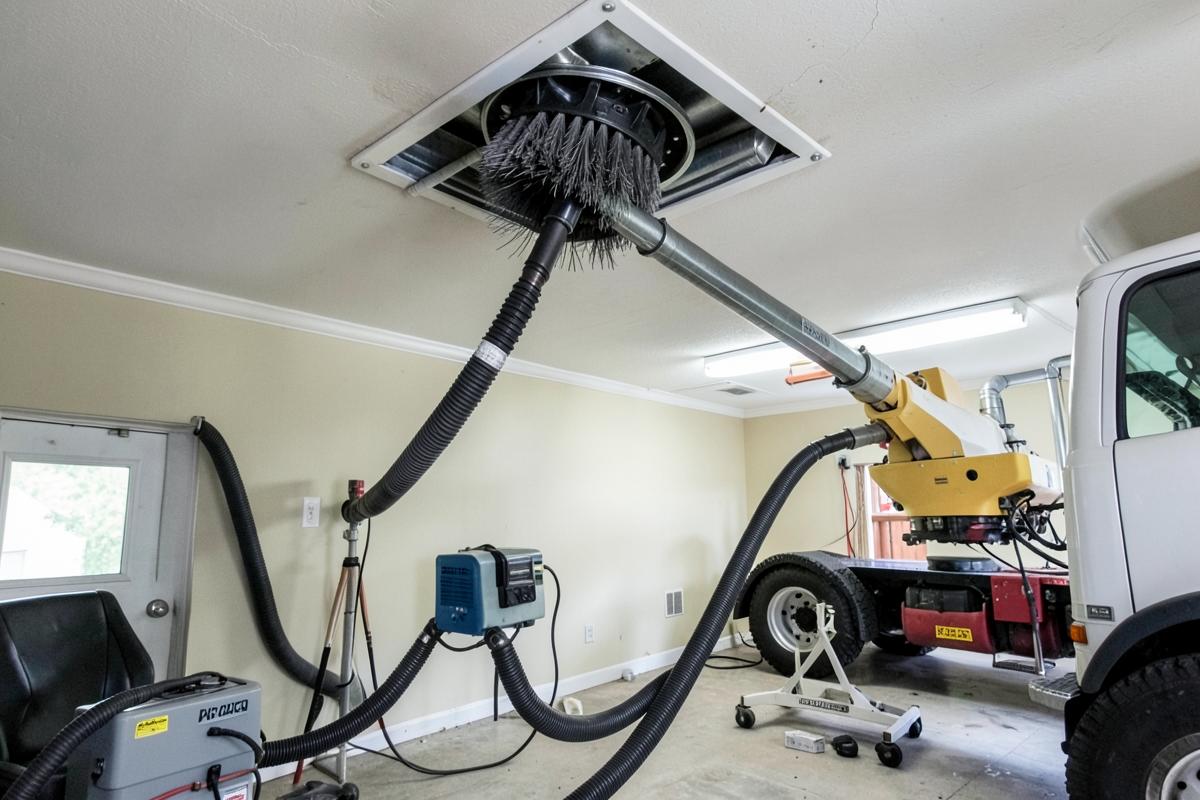
When it is warranted, method matters. We put the system under negative pressure, agitate each branch mechanically so material moves toward the collection point, clean registers and the blower compartment, and photograph representative runs before and after.
What the visit includes
- System survey and access point planning
- Negative air containment on the trunk
- Mechanical agitation of each supply and return branch
- Register, grille and blower compartment cleaning
- Before and after photo documentation
Signs you need this
- Recent renovation or construction dust
- Visible debris or dust blowing from registers
- Evidence of rodents or nesting in ductwork
- A musty smell when the furnace or air conditioning starts
Areas we cover around St. Marys
Kirkton · Granton · Thorndale · Stratford · Embro
Forced-air heating and cooling systems move an enormous volume of air through a house every day, and every bit of that air passes through the same ductwork week after week. Dust, pet dander, construction debris left behind by a renovation, and the fine grit that settles out of household air all accumulate along duct walls over time. Air duct cleaning removes that buildup from the supply and return runs, the plenum, and often the coil area near the furnace, restoring the ducts closer to the condition they were in when the system was installed.
Homeowners in Ontario tend to think about their chimney and their furnace as separate systems serviced by separate trades, but many chimney and hearth companies also handle duct cleaning because the equipment and the debris-handling skills overlap closely with flue and vent work. A negative-pressure vacuum, a set of rotary agitation brushes, and a careful eye for what is actually clogging a run versus what is just cosmetic dust are the same tools and judgment used across both trades.
This page sets out what a proper duct cleaning involves, when it is actually worth doing versus when it is a low-value add-on, what it costs across a typical Ontario home, and how to tell a thorough job from a rushed one. It is aimed at homeowners dealing with new allergy symptoms, buyers of an older house with unknown duct history, and anyone who has just finished a renovation that filled the house with fine drywall dust.
What actually gets cleaned during a full service
A complete duct cleaning covers more than the visible supply registers most people picture. The technician disconnects or seals off the furnace from the duct system, connects a powerful vacuum collection unit to the trunk line, and then works room by room, opening each supply and return register and running a rotary brush or air whip through the branch line while negative pressure pulls loosened material back toward the collection point rather than pushing it into the living space.
The main trunk lines, which carry the largest volume of air and collect the thickest layer of settled dust, get the most attention, followed by branch runs to each register. The plenum above or beside the furnace, the blower compartment, and the evaporator coil area for homes with central air conditioning are typically included as well, since all of that hardware sits directly in the airstream and accumulates the same debris as the ducts themselves.
A thorough job also inspects duct connections and seams while the covers are off, noting any disconnected sections, crushed flex duct, or gaps at register boots that are leaking conditioned air into a wall cavity or floor joist space rather than into the room it was meant to heat or cool. That inspection does not fix the leak, but flagging it is a normal part of a proper visit and often leads to a worthwhile follow-up repair.
- Main supply and return trunk lines
- Individual branch runs to each register
- Furnace plenum and blower compartment
- Evaporator coil area on central air systems
- Register boots, grilles and floor vents
Signs that duct cleaning is actually worth doing
Visible dust blowing out of registers when the system first kicks on, a persistent musty smell that shows up specifically when the furnace or air conditioner is running, or a noticeable increase in dust settling on furniture within days of cleaning it are the clearest practical signals that ducts are contributing to indoor air quality problems. A recent major renovation, especially drywall sanding or flooring demolition done without sealing the registers, is another strong indicator, since fine gypsum and wood dust settles directly into open duct runs.
Homes that have had a rodent or insect infestation in the attic or crawlspace where ductwork runs are a special case, since droppings, nesting material and shed insulation can end up inside ducts through gaps at connections, and that debris carries a health concern beyond ordinary dust that makes cleaning more clearly worthwhile rather than optional.
On the other hand, a newer home with a tight, well-sealed duct system and no particular symptoms does not need cleaning on a fixed calendar schedule the way a chimney needs annual sweeping. Duct cleaning is more of a diagnostic-and-response service than a routine maintenance item, and pushing it as an annual necessity for every household oversells what the science on indoor air quality actually supports.
Households moving into a resale property with no documented duct history sit in a middle category worth mentioning separately. There is no way to know from a walkthrough alone whether the previous owner ever had the ducts serviced, so a baseline cleaning shortly after taking possession, paired with a look at the furnace filter housing and coil, gives new owners a known starting point rather than an unknown one, even in the absence of specific symptoms yet.
What duct cleaning does not fix
It is worth being clear about the limits of the service, because it is sometimes sold as a cure for problems it cannot touch. Duct cleaning will not resolve a mould colony growing inside a wet crawlspace or a leaking humidifier connection; it will remove any mould spores that have settled inside the ducts themselves, but the moisture source needs its own separate remediation or the contamination returns within weeks.
It also will not correct a duct system that was poorly designed from the start, with runs that are too small for the register they feed or too many bends restricting airflow to a room. Those are airflow-balancing and sizing issues that a cleaning crew can flag but not solve, and a homeowner chasing a persistently cold or hot room should expect to need a separate airflow assessment rather than assuming cleaning alone will fix it.
Sanitizing and antimicrobial treatments
Some duct cleaning packages include an antimicrobial fogging or coating treatment applied after the mechanical cleaning is finished, marketed as controlling odour and inhibiting mould growth on interior duct surfaces. These products are generally registered for use in HVAC systems and applied at label-specified concentrations, but they are an add-on to the mechanical cleaning, not a substitute for it, since a coating sprayed over a duct still coated in dust does very little.
Homeowners with chemical sensitivities or young children in the house should ask specifically what product is being used and review the safety data before agreeing to a fogging step, since not every household wants an added chemical treatment even when it is applied correctly, and a straightforward mechanical clean without any additive is a perfectly complete service on its own.
- Ask what product is used and request the safety data sheet
- Confirm mechanical cleaning is complete before any coating is applied
- Treatment is optional, not a required part of a proper cleaning
Furnace and coil considerations during the same visit
Because the technician is already working with the furnace disconnected from the duct system, many households use the same appointment to have the blower wheel cleaned and the furnace filter housing inspected, since a dirty blower wheel is a common source of the musty smell that homeowners mistake for a duct-only problem. This is a reasonable bundle since it uses time already on site rather than requiring a separate call.
The evaporator coil, if the home has central air conditioning, deserves particular attention during this visit, since a coil coated in dust loses efficiency and can develop mould in the moisture that naturally condenses on it during cooling season. Cleaning the coil is more delicate than duct brushing and should be done with fin-safe tools rather than the same rotary brush used on sheet metal duct runs.
How access and duct material affect the work
Rigid sheet metal duct, the most common material in Ontario homes built before the 1990s, tolerates rotary brushing well and cleans thoroughly with standard equipment. Flexible insulated duct, common in additions and newer construction, needs a gentler approach since aggressive brushing can tear the inner liner, so technicians typically rely more on high-velocity air whips and vacuum extraction than mechanical brushing for those runs.
Homes with duct runs buried in a slab or finished basement ceiling with limited access panels take longer to service properly and sometimes require a homeowner to accept that a small number of runs simply cannot be reached without opening finished surfaces, which is not something a duct cleaning appointment includes.
Choosing between whole-home and partial service
A full whole-home cleaning covering every register, the trunk lines, and the furnace components is the standard offering and the one that actually addresses system-wide dust and allergen buildup. Some companies offer a discounted partial cleaning covering only the main trunk and a handful of registers, which can be reasonable for a targeted problem such as dust concentrated in one wing of the house, but it should be priced and described honestly as partial rather than marketed at a whole-home price.
Homeowners comparing quotes should ask exactly how many registers and returns are included, whether the furnace and coil are part of the price or an add-on, and whether the quote is a flat rate or contingent on what the crew finds once they open the first few registers, since some low advertised prices are designed to be upsold heavily once the crew is already inside the house.
- Confirm the number of registers and returns included in the price
- Ask whether furnace and coil cleaning are included or extra
- Get a firm flat rate rather than an estimate subject to upsells
Air Duct Cleaning cost in St. Marys
A typical Ontario duct cleaning for a single-furnace home runs roughly $450 to $700 depending on vent count and add-ons.
| Work | Typical range | What moves the price |
|---|---|---|
| Whole-home cleaning, up to 10 ventstypical bungalow or small two-storey with one furnace | $400 – $600 | typical bungalow or small two-storey with one furnace |
| Whole-home cleaning, 10-20 ventslarger two-storey or homes with a finished basement | $550 – $850 | larger two-storey or homes with a finished basement |
| Furnace and blower wheel cleaning add-onbundled with duct work during the same visit | $80 – $150 | bundled with duct work during the same visit |
| Evaporator coil cleaning add-oncentral air conditioning systems only | $100 – $180 | central air conditioning systems only |
| Antimicrobial fogging treatmentoptional, applied after mechanical cleaning is complete | $120 – $220 | optional, applied after mechanical cleaning is complete |
| Dryer vent cleaning bundled with duct servicecommon add-on since equipment is already on site | $60 – $110 | common add-on since equipment is already on site |
Ranges are estimates for planning only, not quotes. Final pricing depends on what we find on site, access, and the condition of the existing system.
What moves the price
- Number of supply and return registers in the home
- Whether the furnace, blower and coil are included in the quote
- Duct material and how much of the run is accessible without opening finished ceilings
- Evidence of rodent activity, mould or heavy renovation dust requiring extra time
- Number of separate HVAC systems or zones in larger homes
- Whether an antimicrobial or sanitizing treatment is added
Want a number for your own fireplace? Send us the details and we will come back with an estimate, or call (833) 949-4153.
How the work goes, step by step
- 1
Initial walkthrough
The technician counts registers and returns, checks the furnace and coil condition, and confirms the scope of work with the homeowner before starting.
- 2
Seal and isolate
The furnace is disconnected from the duct system and a collection vacuum is connected to the main trunk to create negative pressure across the ductwork.
- 3
Agitate and extract
Each branch run is opened at its register and worked with a rotary brush or air whip while the vacuum pulls loosened debris toward the collection unit.
- 4
Clean furnace components
The blower wheel, plenum interior and coil, where included, are cleaned separately using tools appropriate to their delicate fins and surfaces.
- 5
Reassemble and test
Registers and returns are reinstalled, the furnace is reconnected, and the system is run briefly to confirm normal airflow and no loose covers.
- 6
Report findings
Any disconnected ducts, damaged boots or airflow issues noticed during the work are documented for the homeowner, separate from the cleaning itself.
How long it takes: A whole-home cleaning for an average single-furnace house typically takes two to four hours depending on vent count and access.
Looking after it afterwards
- Replace furnace filters on the manufacturer's recommended schedule, not just after a cleaning
- Seal registers with plastic sheeting during any future renovation or sanding work
- Address moisture sources such as a damp crawlspace before they recontaminate cleaned ducts
- Keep pet grooming and vacuuming on a regular schedule to slow dust re-accumulation
- Schedule the next cleaning based on symptoms or renovation activity rather than a fixed yearly date
Mistakes we see most often
- Booking based only on an unusually low advertised price without confirming scope
- Assuming cleaning will resolve a mould or moisture problem elsewhere in the house
- Skipping the furnace and coil to save money when they sit in the same airstream as the ducts
- Not sealing registers during a renovation and then expecting cleaning alone to undo the mess
- Choosing a company that cannot explain what equipment it uses to create negative pressure
Questions homeowners ask
- How often do ducts need cleaning?
- There is no fixed interval. Base it on condition and events like renovations or pest problems rather than a calendar.
- Will it help my allergies?
- Sometimes, though filtration and humidity control usually make more difference. We will tell you if we think your money is better spent elsewhere.
- Does duct cleaning help with pet allergies specifically?
- It can help by removing accumulated dander that has settled inside the runs and recirculates each time the blower cycles, though it will not eliminate an allergy entirely on its own, since dander also continually resettles on furniture, bedding and floors from the pet's ongoing presence in the home.
- What should I do to prepare the house before the crew arrives?
- Clearing furniture away from registers and returns so technicians can access every cover, securing pets in a room away from the work area, and confirming ahead of time which rooms have registers that may be temporarily loud during their turn in the sequence all help the visit go smoothly.
- How often should ducts actually be cleaned?
- There is no fixed universal schedule the way there is for chimney sweeping. Most homes without particular symptoms or recent renovation dust can go many years between cleanings, while homes with allergy complaints, visible dust at the registers, or a recent infestation should be cleaned in response to those specific triggers rather than on a calendar.
- Will duct cleaning lower my heating bills?
- Any efficiency gain is usually modest and comes mainly from a cleaner blower wheel and coil rather than the duct runs themselves, so it should not be sold as a significant energy-saving measure on its own.
- Is dust in the house always coming from the ducts?
- Not necessarily. Household dust also comes from fabrics, occupants, pets and outdoor air infiltration, so a duct cleaning addresses one contributor among several and may not eliminate dust entirely on its own.
- Can duct cleaning damage older ductwork?
- Aggressive brushing on already-deteriorated flex duct or thin, rusted sheet metal can occasionally cause damage, which is why an experienced technician adjusts tool choice and pressure to the material and condition found on site rather than using one method everywhere.
- Do I need to leave the house during the work?
- No, the process uses containment and negative pressure specifically so occupants can remain home, though rooms with registers open for cleaning will have some noise from the vacuum equipment for the duration of that portion of the job.
- Should duct cleaning be done before or after a renovation?
- After, ideally once all sanding, cutting and demolition dust has settled, since cleaning before a renovation only means the ducts get recontaminated by the work that follows.
Nearby
Other Communities Near St. Marys
Related work
Often Booked Together
Dryer Vent Cleaning in St. Marys
Full-length lint removal from dryer ducting, with airflow testing at the termination.
Dryer Vent Repair in St. Marys
Rerouting, resealing and replacing crushed, disconnected or improperly vented ducting.
Chimney Fan in St. Marys
Mechanical draft fans for chimneys that cannot draft adequately on their own.
Chimney Sweeping in St. Marys
Full mechanical sweep of the flue, smoke chamber and firebox with containment and photos.